

AIDA marketing is the OG of customer journey models, helping brands turn prospects into loyal buyers. As one of the earliest and most influential marketing framework models, it provides crystal-clear touchpoints for consumer behavior — attention, interest, desire and action — throughout every step of the sales funnel and the purchasing decision cycle.
In other words, the AIDA model is a strategic shorthand for how to attract attention, nurture curiosity, create desire and prompt decisive action so a potential customer becomes a loyal advocate.
But today’s consumers expect a little something extra — whether that’s personalization, immersive experience, genuine emotional connection or all of the above. So, does the AIDA funnel still hold up, or has it been surpassed by more adaptable frameworks in modern marketing communications? More importantly, what should you be doing about it?
What Is the AIDA Model?
AIDA stands for “attention, interest, desire and action.” It’s a pattern that remains relevant across industries, media types and even generations.
The AIDA model outlines the customer journey, mapping the cognitive stages from initial awareness to final purchase. It was born in 1898 when Elias St. Elmo Lewis (often cited simply as Elmo Lewis) introduced the concept as a sales and advertising framework. AIDA has since evolved and now underpins countless marketing campaigns.
This framework follows a linear path, yet it’s historically been remarkably effective in capturing consumer behavior and clarifying the hierarchy of effects that culminates in conversion.
Here’s how it works and why each stage of AIDA remains relevant:
- Attention: The goal here is simple: Get noticed. In today’s attention economy, it’s the sensory cues — targeted messaging, arresting headlines, witty copy and scroll-stopping visuals — that spark curiosity, foster brand awareness and establish a positive first impression.
- Interest: At this stage, the audience doesn’t just see you; they want to learn more. They’ll explore your offer, weigh their options and consider how it fits their needs. Marketers who weave memorable stories, informative data points and problem-solving benefits into their marketing communications help curiosity blossom into genuine engagement.
- Desire: For interest to transform into desire, audiences want to feel seen, validated and important. It’s about evoking a deeper feeling — the attention-desire connection — that makes people picture how the solution will elevate their lives.
- Action: This is the tangible culmination of every previous stage. A well-timed CTA nudges the prospect to click “Buy Now,” request a demo or sign up for that newsletter — converting awareness into an action or purchase and, ultimately, revenue.
But the customer journey is only half of the equation. A brand’s ability to meet consumers at each stage of the AIDA model and tailor messages accordingly is what propels audiences through the funnel.
Subscribe to
The Content Marketer
Get weekly insights, advice and opinions about all things digital marketing.
Thanks for subscribing! Keep an eye out for a Welcome email from us shortly. If you don’t see it come through, check your spam folder and mark the email as “not spam.”
How Marketers Apply AIDA in Messaging Frameworks
The marketing AIDA model unlocks the inner workings of a customer’s process throughout the purchasing decisions they make every day. Responsive messaging helps them understand exactly what they need to know — and feel — before converting. Used correctly, AIDA acts as both a sales funnel blueprint and a practical checklist for marketing strategies across social media marketing, email, paid ads and content marketing articles like this one.
So, how do you apply the AIDA principles in your daily outreach and marketing campaign planning?
First Step: Attention
This is where brands must secure prime real estate in the minds of every potential customer. Too often, marketers assume their target audience is already aware of their offering, but awareness is never automatic — you must intentionally attract attention.
Use creative disruption (also known as guerrilla marketing) to break the monotony of everyday experiences. Placing messages in unexpected contexts compels the audience to stop and take notice. Think bold typography in social media ads, provocative imagery on billboards or interactive stories that invite a swipe-up. Provocative visuals, highly personalized copy or even humor can jolt prospects out of scrolling autopilot, transforming passive attention into active consideration.
Second Step: Interest
Once you’ve gained attention, it’s time to hold it. Generating interest calls for more than just serving information on a silver platter: You need to deliver it in a captivating way that resonates with the evolving stages of AIDA and the nuances of your segment’s desires.
The first step in achieving this is defining your target audience. By knowing who they are, where they gather online and why your solution matters to them, you can craft marketing communications that feel tailor-made.
Then, deliver visually engaging, snackable and insight-rich content — from explainer videos on social media to value-packed blog posts — that speaks directly to your audience’s pain points and aspirations. When your messaging seamlessly aligns with what matters most to them, interest naturally heightens.
Third Step: Desire
Interest will naturally lead to desire once the consumer envisions themselves at the core of your offering. But that transition requires a strategic spark. At this stage, your job is to convince the consumer not only that they want the product, but that they need it in order to reach a larger ambition — maybe clearer skin with premium skin care products, greater productivity through cloud software or social kudos from the latest tech gadget.
Behind every desire for a product or service is something fundamentally human: a need for acceptance, connection, less stress, more time or elevated status. Demonstrate how the product or service provides value beyond the superficial and emphasizes benefits that resonate emotionally. Case studies, testimonials and influencer shoutouts can solidify trust while sharpening the attention-desire-action pathway toward conversion.
Fourth Step: Action
The final stage in the AIDA marketing framework is where all your efforts culminate. This is where you deliver a compelling action or purchase opportunity. Make your call to action unmistakable, friction-free and infused with urgency — whether that’s offering limited-time discounts, bonus content for early sign-ups or instant access to a coveted download.
Without urgency, even the most powerful narrative can fade. Challenge your audience to move decisively toward their desired outcome — purchasing, subscribing or scheduling a demo. By eliminating obstacles, you transform interest into measurable results and close the loop on the AIDA marketing journey.
Granted, consumers are more savvy about their role in the commerce ecosystem these days. Thanks to emerging tactics like social media expanding reach, generative AI scaling outputs and predictive AI enhancing personalization, brand messaging is louder and more cluttered than ever. But this doesn’t necessarily make the AIDA funnel defunct. Rather, it’s a call to view and adapt the framework through a fresh, omnichannel lens.
AIDA’s Pros and Cons
The AIDA model remains a cornerstone of marketing strategy because it encapsulates the core dynamics of the customer journey. Its simplicity is a strength — marketers can easily map it to their tactics, campaigns and goals, ensuring clarity at every stage. Yet, it’s not without its limitations. Let’s explore the pros and cons of the AIDA funnel in a modern context:
AIDA Pros
- Customer journey focus: AIDA provides a clear structure to understand and chart the customer journey, focusing on the progression from awareness to action. This allows marketers to develop targeted marketing strategies at every milestone.
- Simple and clear: Its straightforward, no-frills framework makes it easy to grasp, teach and implement — ideal for swift team alignment and quick marketing campaign launches.
- Versatile: Thanks to this simplicity, AIDA’s blueprint flexes across digital ads, blog posts, emails, landing pages and even traditional marketing and advertising channels.
- Goal-oriented: The model is relentlessly focused on outcomes — conversion and action. That clarity keeps creative brainstorming tethered to business objectives and revenue metrics.
AIDA Cons
- Linear: The AIDA model assumes a linear journey, which doesn’t capture today’s multi-device, stop-and-start buying patterns. Modern shoppers loop, lurk and leap across channels, sometimes in reverse.
- Oversimplified: By omitting post-purchase moments such as retention and advocacy, traditional AIDA doesn’t fully embrace the ongoing dialogue brands must cultivate to sustain loyalty.
- Limited personalization: Consumers crave hyper-relevant, data-driven experiences. Classic AIDA offers no built-in mechanisms for the advanced segmentation, adaptive marketing communications or dynamic social media marketing journeys that define 21st-century commerce.
As audience expectations evolve, brands must understand that a one-size-fits-all framework might no longer suffice. Customers now want personalized, context-driven engagement at every stage. Using AIDA as a foundational guide — and layering modern content marketing insights on top — gives you the best of both worlds: structure and flexibility.
Variations of the AIDA Model
- AIDCAS (Attention, Interest, Desire, Confidence, Action, Satisfaction): This variation builds on AIDA by adding confidence and satisfaction. Recognizing that trust and post-purchase delight are crucial for retention, AIDCAS extends the journey beyond the checkout.
- REAN (Reach, Engage, Activate, Nurture): REAN focuses on long-term relationships. It underscores that marketing campaigns must move past conversion to ongoing engagement and value delivery.
- NAITDASE (Need, Attention and Interest; Trust, Desire and Action; Satisfaction and Evaluation): NAITDASE highlights that marketing communications should cultivate trust before purchase and encourage evaluation afterward.
Examples of AIDA in Action
So, how does AIDA look in the real world? Let’s explore how eight brand giants and innovators employ the framework to nurture the customer journey and influence purchasing decisions:
Netflix: Setting Up the CTA Early
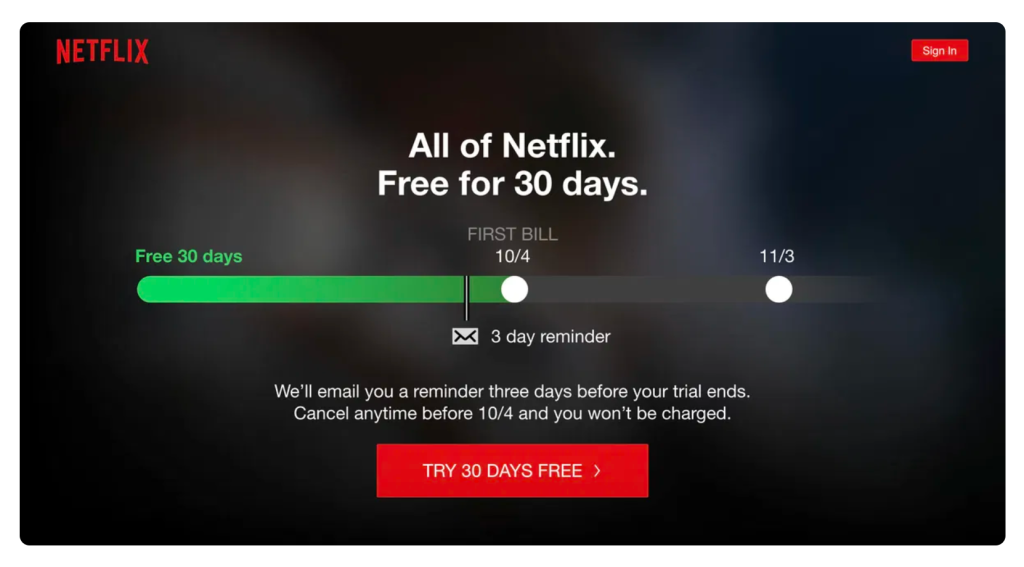
As Netflix caught the first wave of digital streaming, competing with Amazon Prime and HBO, it captured attention by offering a free trial. Users immersed themselves in blockbuster movies and binge-worthy series, which nurtured interest. Desire grew as personalized recommendations highlighted titles tailored precisely to each viewer’s taste. When the trial expired mid-season, a perfectly timed CTA urged an action purchase: “Keep watching — subscribe now.” Netflix phased out free trials in 2020, but by then it had locked in millions of potential customers and fortified its market dominance.
L’Oréal: Creating Desire Through Education

Liquid eyeliner can be intimidating. L’Oréal understood this barrier and leveraged content marketing to bridge the gap. Through quick TikTok reels and deep-dive YouTube tutorials, the beauty giant not only showcases products but also educates consumers on technique. The approach ignites attention, cultivates interest with how-to hacks, stirs desire for flawless looks and seals the deal with product-tagged “Shop Now” buttons. For a portfolio brimming with skin care and skin care products, the model scales across countless shades, serums and serendipitous moments of discovery.
Duolingo: Gamifying Language Learning
Language-learning app Duolingo harnesses push notifications and playful streaks to attract attention on mobile devices. Engaging micro-lessons sustain interest, while leaderboards and achievement badges escalate attention and desire into friendly competition. Limited-time XP boosts and “Keep Your Streak Alive” prompts encourage in-app purchases, completing the attention-desire-action cycle in a way that feels like a game, not a sales pitch.
Apple: The Product Launch Masterclass
Each Apple keynote is a live demonstration of AIDA in full force. The sleek teaser videos and mystery invites drum up global brand awareness and model attention weeks in advance. On stage, crisp demonstrations highlight features that answer burning consumer questions, cementing interest. Next comes desire: aspirational lifestyle imagery and social proof frame each device as a status symbol. Finally, “Pre-order starts now” headlines push millions toward instantaneous product purchase behavior.
Got Milk?: A Classic Advertising Win
The iconic “Got Milk?” campaign used striking visuals and catchy copy to capture attention in magazines and TV spots. By depicting the discomfort of eating cookies without milk, it created palpable desire for that refreshing sip, prompting immediate action in grocery store aisles. Decades later, it remains a hallmark of persuasive advertising.
B2B SaaS: HubSpot’s Free Tools
HubSpot’s free CRM and marketing tools entice small businesses seeking efficiency. The no-cost offer secures attention; intuitive dashboards and quick wins foster interest. Value-driven webinars and case studies escalate desire, while tiered upgrade CTAs guide users toward action, showcasing AIDA’s power in complex B2B journeys.
Ecommerce/DTC: Allbirds’ Sustainable Storytelling
Shoe retailer Allbirds grabs attention with minimalist design and eco-friendly imagery. Blog posts and social content nurture interest by explaining the science behind merino wool. Transparent sustainability reports deepen desire, while frictionless checkout and free returns remove barriers to action.
Email Marketing: Limited-Time Offers From Airbnb
Airbnb’s “Book Now for Summer” emails place a dreamy hero image front-and-center to win attention. Personalized destination picks and price comparisons hold interest. Countdown timers and scarcity cues amplify desire, culminating in a bold “Reserve Your Stay” CTA that drives immediate action or purchase.
Choosing the Right Messaging Model for Your Brand
AIDA’s simplicity and goal-oriented focus made it invaluable when consumer interactions with brands were more straightforward. However, as consumer expectations grow more sophisticated, the model’s linearity and limited personalization can become constraints.
Yet, this doesn’t mean you should abandon AIDA or rush headlong into a new framework without reflection. Treat AIDA as a foundational compass within a broader marketing strategy. Use it to ensure every message has a clear purpose: attention, interest, desire, action. Then layer in data-driven insights, omnichannel touchpoints and customer-centric storytelling to transform that foundation into a dynamic, adaptive marketing AIDA model. Ultimately, embracing a more agile and personalized approach will help you build lasting relationships — which hold far more long-term value than a simple close.
Editor’s Note: Updated July 2026.