

AI-generated content is now a standard part of many marketing workflows. Teams are using it to accelerate research, draft copy faster and scale content production more efficiently than ever before.
But despite growing adoption, marketers still have serious concerns about content quality.
In our latest AI marketing survey, we asked 132 marketers currently using AI in their workflows: “What are the biggest concerns you have for content quality using AI?”

Here’s what they told us:
- The content is thin or generic-sounding: 87 respondents.
- It references outdated or incorrect information: 51 respondents.
- It takes too long to get the output to reflect the level of quality or authority audiences expect: 46 respondents.
- It doesn’t reflect our expertise: 43 respondents.
Interestingly, concerns about off-brand messaging and irrelevant audience targeting ranked much lower this year than they did previously. That may suggest marketers are getting better at prompting and workflow management.
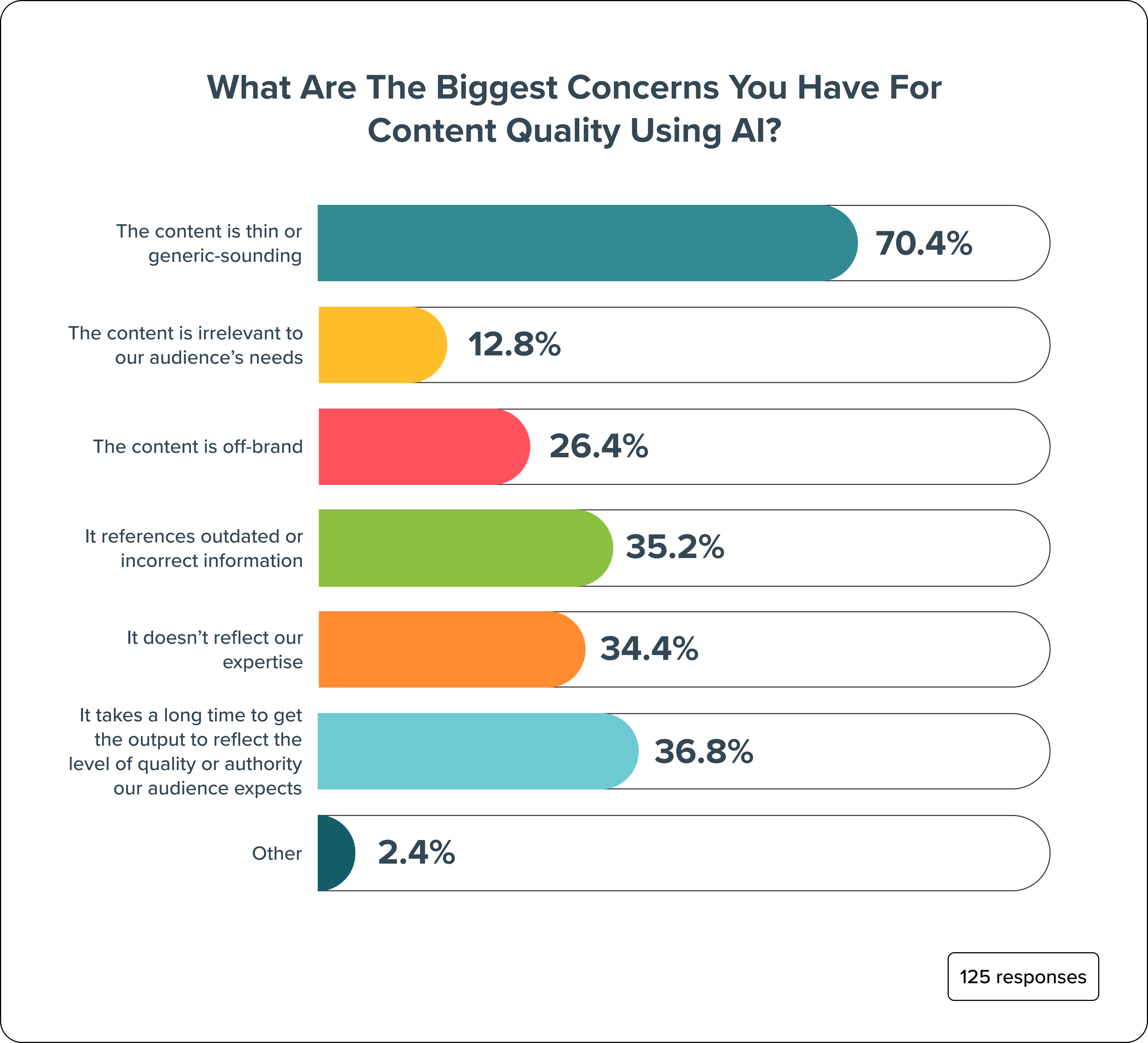
Instead, the biggest challenges now center around authority, expertise and differentiation.
Let’s break down what these findings reveal about the current state of AI content creation — and where marketers are still struggling most.
Generic-Sounding Content Is Still the Biggest Problem
The top concern wasn’t factual accuracy. It wasn’t SEO performance. And it wasn’t even brand voice. The biggest issue marketers reported was that AI-generated content still sounds generic. Eighty-seven respondents selected “The content is thin or generic-sounding,” making it the clear frontrunner.
That’s telling, because despite all the progress in AI tools over the last year, marketers still feel like much of the output lacks originality, depth and personality. The writing may technically answer the prompt, but it often feels flat, repetitive or interchangeable with everything else online.
That’s why some editors add a humanizer AI pass to their workflow, using it to break up repetitive phrasing so the human edit can focus on expertise and voice.
Interestingly, the people most concerned about this were experienced marketers. Respondents with 11+ years of experience represented the largest group selecting this concern, followed heavily by marketing managers and directors. That likely isn’t a coincidence.
Experienced marketers know what differentiated content looks like. They understand audience nuance, brand positioning and strategic messaging. They’re also more likely to recognize when content sounds polished on the surface but ultimately says very little.
The budget data also reveals something interesting. Among respondents concerned about generic output:
- 26 said they only use free AI tools.
- 52 said they have a small AI budget.
- Only 9 said AI tools are a key component of their martech stack this year.
That doesn’t necessarily mean paid tools completely solve the problem. But it does suggest marketers relying primarily on free, general-purpose AI tools may be more likely to encounter repetitive or low-quality outputs.
Subscribe to
The Content Marketer
Get weekly insights, advice and opinions about all things digital marketing.
Thanks for subscribing! Keep an eye out for a Welcome email from us shortly. If you don’t see it come through, check your spam folder and mark the email as “not spam.”
Why AI Content Often Sounds Generic
Most AI tools are trained to predict statistically likely language patterns. That’s useful for generating readable copy quickly, but it can also lead to sameness.
The output tends to default toward:
- Overused phrasing.
- Safe language.
- Broad generalizations.
- Surface-level explanations.
- Repetitive sentence structures.
That’s especially noticeable in industries where audiences expect strong opinions, technical expertise or firsthand experience. The more specialized the topic becomes, the easier it is to spot generic AI writing.
How Marketers Are Improving AI Output
The marketers getting the strongest results from AI usually aren’t relying on one-shot prompting. They’re building more structured workflows around the tools.
That includes:
- Feeding AI detailed source material.
- Using highly specific prompts.
- Providing examples of brand voice.
- Incorporating SME insights.
- Editing heavily before publication.
Purpose-built marketing AI platforms can also help by incorporating workflows, structure and brand context into the generation process, but ultimately, AI still performs best when paired with human direction.
The strongest content usually comes from combining machine efficiency with real editorial judgment and expertise.
Marketers Still Don’t Fully Trust AI Accuracy
The second-largest concern reported by marketers was outdated or incorrect information. Fifty-one respondents selected this issue, and this concern may be one of the hardest to solve.
AI tools can produce highly confident-sounding copy even when the information is inaccurate, outdated or entirely fabricated. For marketers working in technical, regulated or fast-moving industries, that creates a major trust problem.
What’s particularly interesting is that this concern remained relatively high even among respondents investing more seriously in AI tools. Among respondents worried about inaccurate information:
- 15 use only free tools.
- 31 have a small AI budget.
- 5 said AI tools are now a key part of their martech stack.
That last number may seem small, but proportionally it stands out. Even marketers investing heavily in AI still don’t fully trust the output, and that hesitation makes sense. AI models often pull from broad internet datasets that may include:
- Outdated content.
- Conflicting sources.
- Inaccurate summaries.
- Missing context.
Without proper guardrails, AI can blend those issues into content that sounds authoritative while quietly introducing factual problems.
Why This Creates Workflow Issues
One of AI’s biggest selling points is speed. But for many teams, fact-checking and verification are becoming major operational bottlenecks. Generating content may only take minutes, but validating it can take significantly longer. That’s especially true in industries where accuracy matters deeply, including:
- Finance.
- Health care.
- Manufacturing.
- Education.
- Professional services.
For these organizations, publishing inaccurate information isn’t just embarrassing. It can damage credibility and trust.
How Teams Are Reducing Accuracy Risks
Many marketers are becoming more intentional about what information AI can access. Some teams now:
- Restrict sourcing to internal documentation.
- Provide approved reference materials.
- Feed AI product documentation or SME interviews.
- Use AI primarily for structure and drafting instead of research.
Specialized AI marketing platforms are also beginning to offer more controlled sourcing capabilities, allowing marketers to guide where information comes from. But regardless of tooling, human review remains essential.
AI can accelerate content creation. It still cannot independently verify truth.
Getting AI Content To ‘Publish-Ready’ Takes Longer Than Expected
One of the most revealing findings from this year’s survey is that marketers aren’t necessarily struggling to generate content quickly, but struggling to get it to publication quality quickly.
Forty-six respondents said it takes too long to get AI-generated content to reflect the level of quality or authority their audience expects. There’s a growing realization across marketing teams that generation speed and production speed are not the same thing.
AI can absolutely accelerate first drafts. But extensive editing, restructuring, fact-checking and rewriting often reduce the time savings marketers initially expected. Senior marketers once again represented the largest group selecting this concern.
That likely reflects higher expectations around quality, depth and audience trust.
The Hidden Work of AI Content Creation
Many teams are discovering that AI content creation still requires significant operational oversight. That often includes:
- SME review for accuracy.
- Editorial review for readability and structure.
- SEO review for discoverability.
- Brand review for messaging consistency.
In practice, this means AI isn’t replacing content workflows so much as reshaping them. The marketers seeing the best results are usually treating AI as a collaborator inside existing processes rather than a replacement for strategy or editorial expertise.
Interestingly, this concern appeared much lower among respondents who said AI is deeply integrated into their martech stack. That may suggest more mature AI implementations are getting better at operational efficiency, even if quality concerns haven’t fully disappeared.
AI Still Struggles To Reflect Real Expertise
Forty-three respondents said AI-generated content doesn’t reflect their expertise, and in many ways, this may be the most important finding in the entire survey. Expertise is increasingly what separates valuable content from content that simply exists.
AI is very good at synthesizing commonly available information. What it struggles to replicate is:
- Firsthand experience.
- Nuanced industry perspective.
- Strategic insight.
- Lived operational knowledge.
- Original thinking.
That gap becomes especially obvious in technical or highly specialized industries. Manufacturing and industrial companies appeared repeatedly across concerns related to expertise, relevance and off-brand content.
That pattern may point to a broader challenge with AI-generated marketing: the more niche the industry becomes, the harder it is for generalized AI systems to produce convincing authority without heavy human involvement.
The Irony of AI Content Marketing
One of the most interesting trends emerging from this year’s survey is that AI may actually be increasing the value of human expertise.
As more companies publish AI-assisted content, audiences are becoming better at recognizing generic messaging. Original perspectives, real-world insights and authentic experience become more noticeable by comparison.
That means marketers may need to invest even more heavily in:
- Thought leadership.
- SME collaboration.
- Proprietary insights.
- Original research.
- Human storytelling.
AI can support those efforts. But it still struggles to replace them.
The Future of AI Content Creation Is Probably More Human Than People Expect
Last year, many marketers were still figuring out how to use AI effectively. This year, the conversation feels different. Prompting appears less problematic. Brand alignment concerns are lower. Audience irrelevance ranked surprisingly low overall.
Instead, marketers are now wrestling with bigger questions:
- How do we make AI content feel authoritative?
- How do we preserve expertise and differentiation?
- How do we maintain trust and quality at scale?
Those are much harder problems to solve.
The marketers getting the best results from AI aren’t treating it like an autopilot content engine. They’re treating it like a collaborator — one that still needs strategy, oversight, expertise and editorial judgment.
Based on this year’s survey results, that human layer may actually be becoming more important, not less.