
Quick definition: SEO (search engine optimization) is the process of improving a website’s visibility in traditional rankings and AI-generated answers by making it easier for search engines to crawl, index, understand and rank your pages. It hinges on content quality, technical health, backlinks, user intent, E-E-A-T signals and, increasingly, AI citation factors.
Table of contents
- What Is SEO and How Does It Work?
- SEO Drives Inbound Web Traffic
- How Search Engines Work
- How SEO Works in the AI Search Era (2026)
- What Your Site Architecture Says About You
- Bots, Crawlers and Algorithms
- Keywords and Keyphrases
- Metadata and On-Page Copy
- The Science of Understanding a Search Query
- Internal and External Links
- Why Content Is Important for SEO
- Good SEO vs Bad SEO
- Navigating SERPs in 2026
- SEO Tools (2026 Edition)
- How Long Does SEO Take to Work?
- SEO in Action: A Case Study
- FAQs: SEO in 2026
- See SEO Wins Yourself
Search engine optimization is now more than 2 decades old, yet it’s still a mystery to the common marketer.
We know we need it. We know it works, in theory. But what’s going on behind the scenes?
Understanding SEO goes deeper than blog posts and keywords. There are also algorithms, search bots and artificial intelligence to consider.
So let’s get started.
What Is SEO and How Does It Work?
Search engine optimization (SEO) is the process of increasing organic search rankings by targeting relevant seo keywords, publishing quality content and generating backlinks. Through on-page, off-page, local SEO and technical SEO, marketers make their websites more attractive to search engines like Google and Bing, thus bringing in more organic traffic and leads.
| Type of SEO | What it covers | Example tasks | Who typically owns it |
| On-page SEO | Content and relevance | Keyword research, meta descriptions, internal linking | Content team |
| Technical SEO | Crawlability and performance | XML sitemap, loading speed / Core Web Vitals, structured data | Dev / SEO team |
| Off-page SEO | Authority and trust | Link building, digital PR, social proof | SEO / PR team |
| Local SEO | Geo-specific visibility | Google Business Profile, local citations, reviews | SEO / Marketing |
| GEO / AI Search Optimization | AI citation and answer surfaceability | Fact blocks, entity schema, generative snippets | SEO / Content |
SEO Drives Inbound Web Traffic
SEO is a fundamentally different marketing practice from, say, paid advertising. In decades past, the traditional marketer would pay for ad space in television commercials, on highway billboards, on printed flyers and brochures, via radio and so forth.
In other words, in return for payment, companies would get a small sliver of time and space to showcase their brand and ideas.
It was a very small-fish-in-a-big-pond strategy, and it was always expensive and temporary. With the birth of the internet, consumers generally don’t watch cable TV commercials or call in to radio stations – they’re primarily digital.
As such, marketers had to shift from a disruptive, outbound model – trying to get their brand in front of you – to an inbound model.
With inbound marketing, companies publish content through their websites, social media feeds and email channels. Then they wait for customers to find them. They draw users in, rather than chase them down through costly paid ads.

SEO, as you’ll see, is the dominant inbound marketing tactic. This brings us to the role search engines play in 2026.
How Search Engines Work
If your company is in the market for a new software vendor, you don’t have to ask for business cards or read printed user manuals to get the information you need.
You just use a search engine.

Search engines like Google, Bing and DuckDuckGo are like the planet’s largest, most comprehensive and practical encyclopedias. They inventory and categorize all of the world’s information, from who ruled the Byzantine empire to why your iPhone gets slower with every software update.
Search engines have the answers. You just enter a query into a search bar. Or, more recently, you speak to a voice assistant like Siri or Alexa and they search for you — hands-free.
Imagine for a second that you’re a B2B pharma company and you’re still stuck using spreadsheets and legacy coding systems. You’re ready to upgrade to a cloud-based software.
Where do you begin?
Go to a search engine. Type “cloud software for pharma” and click on what pertains most to you.

You can see that, from a business perspective, being one of those most-clicked results is a clear advantage over competitors. Getting your brand to appear near the top of a search engine results page (SERP) means you’re never more than a click away from billions of online searches.
As a methodology, it’s lightyears ahead of taking out an ad in the local newspaper.
So what’s the first step to creating a successful SEO campaign?
Cleaning up your website.
How SEO Works in the AI Search Era (2026)
What’s Changed Since 2020 — AI Overviews, SearchGPT and Google AI Mode
Generative answers now appear above or alongside classic blue links. Google’s AI Overview, Microsoft’s Copilot Search and emerging “SearchGPT” experiences quote authoritative pages directly, rewarding clear facts, concise definitions and well-marked structured data.
Ranking vs. Citation — Why Being Quoted Now Matters As Much as Being Clicked
Traditional ranking still delivers traffic, but AI surfaces distribute citations that influence brand visibility and trust. Pages with extractable answers, schema and strong algorithm compliance win both rankings and citations.
What Generative Engine Optimization (GEO) Is and How It Fits Inside SEO
GEO is the practice of tailoring content for AI-generated summaries. It emphasizes entity markup, fact boxes and conversational clarity. Marketers have different approaches, and the industry is still learning how best to address the fast-moving changes.
What Hasn’t Changed — Crawling, Indexing, Authority, Intent
Despite flashy new interfaces, search engines still crawl, index and rank pages. E-E-A-T, helpful-content signals, backlinks and matching search queries to intent remain crucial.
- Same fundamentals: Crawlability, relevance, authority, performance.
New layer: AI citation readiness, entity clarity, answer formatting.
What Your Site Architecture Says About You
Your XML sitemap is essentially the skeleton of your website. It operates like a chain of command, with each individual page connecting to another page in some form.
Here’s a standard sitemap:

Search engines understand this sort of framework, so marketers must optimize their sitemaps to make them logically hierarchical and keyword-targeted. That way, search engines can quickly understand what your site is about, how each page relates to others and how it should appear in SERPs.
In other words, the way your site is built and organized — its site architecture — needs to be fundamentally sound.
This means avoiding, among others:
- 404 errors.
- Broken links.
- Zombie pages.
- HTTP URLs.
- Empty metadata.
- Duplicate content.
- Slow page speed.
Your site says a lot about your brand, and improper architecture can mean no one is able to find you and you’re wasting your money by having a site at all.
Bots, Crawlers and Algorithms
When Google evaluates your site and tries to determine how relevant it is to a user, it’s trying to process and contextualize a lot of information very quickly. It uses search bots and search crawlers to scan the internet at lightning speed, assess a web page’s quality and relevance and feed that data into an algorithm.
All of this happens in milliseconds, billions of times a day.
But if your site isn’t properly marked with optimized code and metadata, Google may be unable or unwilling to crawl your site and show it to searchers.
Every positive and negative mark against your site is weighted against the rest of the search landscape (AKA your competition).
Google’s algorithms will compute and render a ranking for your site based on more than 200 specific factors.

10 of the Most Important Search Engine Ranking Factors in 2026
- E-E-A-T and author authority.
- Helpful-Content and user intent alignment.
- Backlinks and brand mentions.
- Core Web Vitals (loading speed, stability, interactivity).
- Mobile-first and accessibility.
- Structured data and entity clarity.
- AI citation worthiness (clean facts, concise definitions).
- User experience signals (dwell time, engagement).
- Content depth & freshness.
- HTTPS security.
Keywords and Keyphrases
Every marketing manager and agency has heard, “I want to rank for this keyword” or “I want to be No. 1 for this keyword” a million times. In a sense, that’s the whole ballgame — to rank as close to the top of SERPs as you can, so you can produce more clicks.
True inbound SEO focuses on narrower, more specific search terms that directly correspond to your business in some way.
For instance, Brafton could choose to write a blog post on every phrase that has the word “content” in it. We do provide content services, after all. But taking such a broad approach means you can spend endless resources on meaningless blog posts that generate only lackluster or spammy leads.
See, the most-searched results with the root keyword “content” aren’t useful or applicable at all:

The more strategic version of SEO in this case would be to prioritize only high-value keywords that are likely to produce qualified leads and quality traffic.
So instead of “content,” we might target “tools to improve your content and copywriting skills.” Someone searching for this type of article is already much more qualified and meaningful to us than someone just typing “content” into Google. These searchers would probably be:
- Interested in actionable tools or services.
- Looking for a comparison of why some tools are better than others.
- Potentially open to learning more about who can provide those tools.
- Seeking helpful information about content and copywriting.
At the end of the article, we would provide additional “Recommended Reading” tailored to readers.

You can see how we’d be involved in the entire user journey, from the moment they query to the time they click on our site. And we know this in advance and plan for content around what they might want to know. That way, Brafton is ever-present and ever-helpful on topics that support our brand and our services.
The distinction between what is a good keyword and what is a bad keyword can be somewhat subjective, based on the period of time you’re writing a post, the type of marketing campaign you’re running and what priorities your boss has.
Objectively, however, longer-tail keywords (4-6 word phrases) are likely to be more cost-effective and valuable to target. That’s because longer phrases are typically searched for less often, but they’re higher quality.
In the example above, “content” is useless as a keyword; it has no contextual relevance or utility, and it could mean anything. The intent of the searcher is completely unknown. “Tools to improve your content and copywriting skills,” on the other hand, says a lot about the searchers querying this phrase.
This allows us to write copy for strategic terms and to get the most bang for our buck every time. Long-tail terms may not get as much search volume each month, but they can still be more lucrative in the long run.
Metadata and On-Page Copy
Once you have a strong grasp of your keyword strategy, how you implement and execute it can separate your brand from the rest of the pack.
Some of the most critical components of making SEO work for you are the text and code with which you mark up your web pages. Metadata is both a front- and backend language that clarifies and optimizes your pages for search engines and readers.
The various types of metadata used in content marketing include:
- Title tags.
- Header tags.
- Canonical tags.
- Robots meta tags.
- Meta descriptions.
- Alt text.
These meta elements tell search engines how your web pages should be crawled and understood, and from that, indexed in SERPs.
Optimizing your pages so that high-value keywords appear in your metadata is an easy-to-implement process that can lead to quick SEO wins.
For example, if you’re writing a blog post about cloud payroll software, putting “cloud HR” in your title tag, meta description and image alt text adds further context to search crawlers, without having to keyword-stuff the actual on-page copy.
If you’re embarking upon an SEO campaign, updating your metadata is an efficient way to re-contextualize and re-focus each page so that it corresponds to a keyword target. Too often, title tags are duplicated across multiple pages without forethought, and other metadata are missing entirely. If this sounds like you, you’re putting up unnecessary obstacles that you should update immediately.
The Science of Understanding a Search Query
No two Google searches are identical.
They might share quite a few similarities, but there are key distinctions between each and every search query.
When a web user types a phrase into a search bar, what are they hoping to do with the information they find? The answer gets to the heart of “search intent,” or what a user intends to say and find when they query.

In our keyword research process, we differentiate between 3 types of search intent:
- Informational: Searchers simply seek information. They are very top-of-funnel.
- Navigational: Searchers want to be connected to other pages and resources but start with a Google query. They can be top- or middle-of-funnel.
- Transactional: Searchers want to complete a commercial transaction, such as buying shoes or setting up a product demo with your sales team. They are middle- or bottom-of-funnel.
How an informational-intent searcher behaves online is much different from a commercial-intent searcher, and you can understand this by looking at the phrasing they use.

Consider these three queries:
- “what is content marketing”
- “brafton SEO ebook”
- “local content services”
In order, we can decipher a few things about each user’s state of mind and how they might want to interact with our brand:
- Informational searcher. They just want helpful resources and guides on general topics.
- Navigational searcher. They may have interacted with or heard of us in the past, and they want to be directed to a specific eBook about SEO. They don’t necessarily need to digest several blog posts beforehand.
- Transactional searcher. They’re looking for pricing and service capabilities from local content providers. They’re clearly hoping to begin or finalize a sales process so they can purchase content services soon.
As you discover these varying degrees of intent, you can build content that’s more targeted and funnel-specific. In this way, you increase your chances of ROI and avoid mixed messaging.
Internal and External Links
As readers land on your site, what should they do next?
If you’re a good marketer, you’ll direct them toward other pages of your site or to valuable resources they’ll find intriguing.
In practice, this means providing navigational links to internal and external sources.

In the aforementioned blog post, we’d equip readers with additional steps to take once they reach the end of the article. This provides them a) useful information and b) a route to interact more with our brand.
In the copy itself, too, there would be internal hyperlinks that funnel traffic to related content, thus lengthening total time per session. Keeping users coming back to your site is a definite SEO best practice, and you can do this by creating super engaging content and additional pages to peruse.
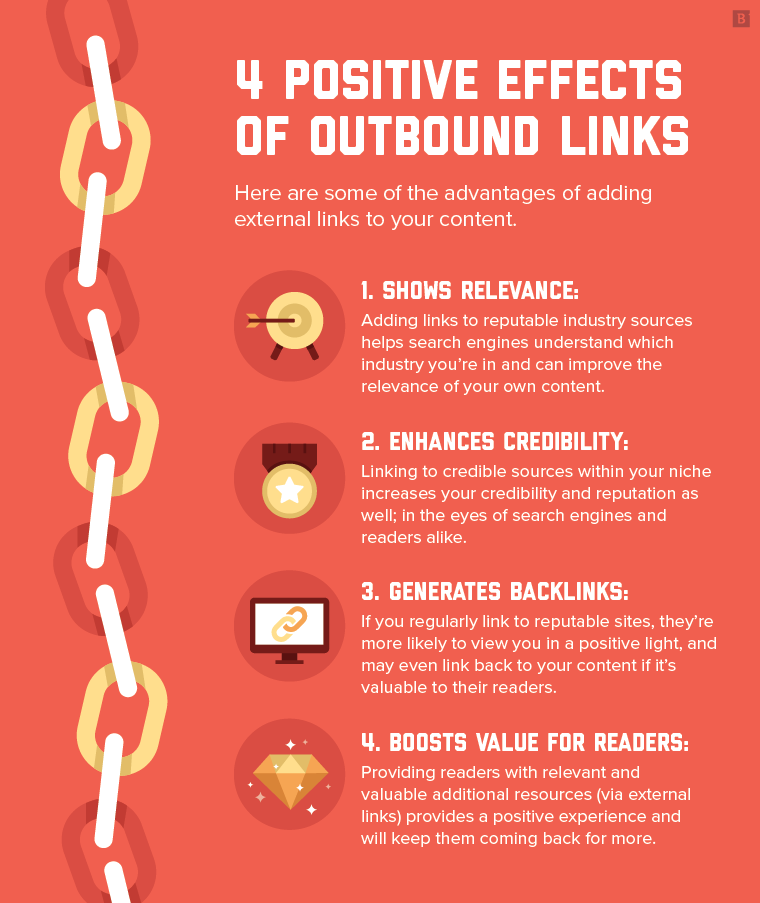
Similarly, your content will likely link out to credible research and data, known as external sources. These links technically send readers away from your site, but they still offer relevant, useful information. External links can also add authority and verification to any claims you make, so search engines and readers know you’re not making false claims or citing disreputable publishers.
Imagine links as a highway system, providing logical and necessary on- and offramps throughout the entire user experience.
Why Content Is Important for SEO
As you’re focusing on the nuts and bolts of creating an SEO-friendly website, much of the user interface with your site will be in the form of content.
Content and SEO are inseparable.
While you can make a certain level of headway in achieving your SEO goals by focusing on limited tasks like writing blog posts, the truth is you should be doing more. Each and every SEO task is critical, and that includes regularly publishing and optimizing content to populate your site and feed search engines.
Content writing allows you to authoritatively write about topics that readers want more information on. This capability can create thought leadership, brand affinity and general organic reach. But the core SEO value of content is that you can comprehensively cover keywords and keyphrases that will generate more traffic and inbound leads.
In essence, content writing is a sales-enablement tool because it improves your overall SEO, thus sending more leads to your sales team. Now it’s up to them to close those deals.
It’s impossible to benchmark an SEO campaign without factoring in which types of content you’ll create, how they’ll be linked throughout your site and how they’ll be measured.
Content performance metrics that should be considered, as they relate to SEO, are:
- Organic visitors.
- Backlinks.
- Goals completed (whether newsletter signup, eBook download, etc.).
- Dwell time.
- Pages per session.
- Click-through rate.
- SERP position.
There’s also video, graphical and interactive content to include in your larger marketing arsenal. Google is able to crawl PDFs, video transcripts and image alt text to understand what these content formats are conveying. Sure, it’s a bit more difficult to parse than traditional text-based content, but it still holds tremendous value for your SEO efforts.
Good SEO vs. Bad SEO
With any form of algorithmic system, there are always those who attempt to cut corners or develop hacks.
Because Google is fairly guarded with respect to its core ranking algorithms and the artificial intelligence that drives it, so-called SEO specialists are constantly devising ways to game the system or discover new ways to quickly show results. This is known as black hat SEO.
Its counterpart, of course, is white hat SEO.
The two practices are the difference between bad SEO and good SEO, so it’s imperative that your digital marketing campaigns fall into the latter camp.
Here are some agreed-upon hallmarks of SEO best practices to ensure you’re not engaging in deceptive techniques:
Dos
- Write high-quality content with plenty of verified data.
- Mark up pages with keyword-optimized metadata.
- Use a flat, logical site structure for easy navigation.
- Use a mobile-responsive site for faster loading times and strong mobile UX.
- Create in-depth content for human readers, not search bots.
- Embed visuals and other interactive features for more engaging content.
Don’ts
- Insert backlinks to your site in the comments section of forums or on social media.
- Disguise text or links by changing font color.
- Create subdomains to house duplicate content and link back to your core domain.
- Keyword stuff.
- Redirect users to different pages that don’t correspond to hyperlink anchor text.
- Use link or content farms.
Navigating SERPs in 2026
Once your SEO content goes live, you’ll notice that not all SERPs are made equal.
Some SERPs now include AI Overview panels, Perspectives carousels, video shorts, voiced answers and People Also Ask modules powered by search engine algorithms. This SERP crowding means more competition — but also more surfaces on which to appear.
Google’s formats evolve continuously, and 2026 has brought AI Mode tabs and interactive answer cards. To compete, content must be structured for both classic rankings and AI extraction.
Today’s content marketers still talk of Position Zero, but AI Overviews often sit even higher. Your pages need to use schema, clear headings and fact lists so they can be quoted as authoritative sources.
SEO Tools (2026 edition)
SEO can be a lot of work, especially if you’re attempting to correct past mistakes.
For a variety of in-demand SEO services, modern AI-enhanced tools can automate some of the more menial tasks:
- Site audit: Screaming Frog, Ahrefs Site Audit, Semrush Site Audit.
- Keyword & entity research: Semrush Keyword Magic, Moz, Perplexity AI.
- Content optimisation: Clearscope, MarketMuse, Surfer SEO, NeuronWriter.
- Ideation: Answer the Public, ChatGPT, Brafton’s in-house briefing tools.
- Link building & analysis: Majestic, Ahrefs Backlink Checker.
- Performance tracking: Google Search Console, Google Analytics 4, Semrush Position Tracking.
Regular SEO audit routines ensure your site aligns with evolving SEO practices and Core Web Vitals.
How Long Does SEO Take to Work?
The 90 – 180-Day Baseline for New Content
New pages often need 3–6 months to earn search engine ranking traction as they accumulate impressions, clicks and backlinks.
Factors That Speed You Up
- Strong domain authority.
- Fast loading speed and good Core Web Vitals.
- Frequent content updates.
- Solid internal-link architecture.
Factors That Slow You Down
- Thin or duplicate content.
- Technical crawl errors.
- Weak backlink profile.
- Ignoring AI citation formatting.
SEO in Action: Case Studies
We do SEO every day of the week, and we’ve seen it work miracles for our brand and our clients firsthand.
Here’s an entire section of our website devoted to these success stories. Check em out!

But let’s call particular attention to a question we commonly get:
How long does it take to work?
Based on our proprietary research and experimentation with multiple tools, we’ve found that SEO-driven content marketing at scale can take 100 days to fully show results (about three months). That’s for organically created content not controlled for other off-site factors.
Older posts have more time to accrue backlinks and traffic, which will boost their value in Google’s eyes. As such, Google’s algorithms are more likely to increase your page rank, pushing you closer to the top of SERPs.
For your purposes, don’t expect a moonshot right out of the gate; that’s just not how SEO works. Evaluate your performance over the course of several months to get a fair, accurate measurement. Then choose for yourself whether you’d like to make additional investments.
FAQs: SEO in 2026
Search engine optimization involves four core phases. First, keyword research identifies what your target audience is searching for. Second, on-page optimization integrates those terms into highly relevant content, title tags and headers. Third, technical SEO ensures search engines can seamlessly crawl and index your site while providing a fast, mobile-friendly user experience. Finally, off-page SEO builds domain authority through reputable external backlinks.
Yes, the foundational elements of SEO are highly accessible. You can comfortably manage keyword research, content creation and basic on-page optimization using standard content management systems and free tools. While complex technical audits or large-scale link-building for enterprise sites often require specialists, individuals and small businesses can successfully execute core strategies to drive meaningful organic traffic.
The Pareto Principle applied to SEO suggests that 80% of your organic growth comes from 20% of your efforts. Instead of getting bogged down in minor technical micro-optimizations, focus your resources on the highest-impact actions: publishing exceptionally useful content, optimizing title tags for click-through rates and earning a handful of high-authority backlinks.
SEO isn’t dead, but its mechanics are evolving. While AI-driven search features (like AI Overviews) now provide direct answers to simple queries, search engines still require high-quality, human-created content to train those models and cite as underlying sources. AI simply makes generic, low-effort content obsolete, placing a heavy premium on original research, unique perspectives and established brand authority.
See SEO Wins Yourself
SEO is an evolving practice, especially as AI impacts the entire landscape. To see big wins on the SERPs, you need to keep up with the good habits that make your website appealing to algorithms and human readers. Remember that GEO is a related but not identical field that deserves its own strategy, too.
Editor’s Note: Updated November 2026.