

Not everything changed about SEO when AI Overviews (AIOs) showed up. Most of it stayed the same. Visibility, click-through rates and how you need to structure your content for search did not.
This article covers what has shifted and what to do about it.
6 Ways AI Overviews Changed SEO
AI Overviews changed SEO by replacing traditional keyword practices with concise answer-first, entity-based synthesis. This shift carries a separate meaning for your content creators, strategists and SEO team. Your audience’s online journey is likely to change the most.
We’re pulling insights from Brafton’s Associate Vice President of SEO, Phil Weafer, to explore what’s changed and the practical realities of staying ahead.
- Synthesis surpasses indexing: Indexing ensures Google and AI scrapers can find and read your content. Synthesis brings it up a notch. To win AIO mentions, your website has to be a trusted source with deep, concise, contextually relevant, data-backed information that large language models (LLMs) can extract and cite.
- Decoupling top-10 rankings: Organic search rankings do not guarantee an AI citation. AI systems prioritize data density, accuracy and extractability over traditional SEO rankings.
- No more teaser intros: Wordy or even narrative intros create processing noise for AI crawlers. In an answer-first world, you want to get to the point, fast — including beneath your H2s and H3s.
- The SERP is the new funnel: Phil advises that the “awareness” stage (or top of the funnel) now happens via AIO citations. The middle of the funnel favors sites that rank for multiple queries in a cluster, i.e., show topical authority. Even if these supporting blogs see reduced traffic, their consolidated authority wins your commercial landing pages the visibility and clicks that drive revenue.
- The zero-click reality: Top-of-funnel informational clicks have declined in favor of AIO responses. But traffic from AI Overview citations brings audiences with higher conversion intent. You should expect reduced and more targeted traffic from people further along the funnel.
- Share of voice and mentions: The days of shooting for No. 1 in Google Search are dwindling: brands have to share the stage now. Traditional CTR and keyword tracking are no longer your core AI search indicators — start measuring mentions and traffic referrals instead.
Subscribe to
The Content Marketer
Get weekly insights, advice and opinions about all things digital marketing.
Thank you for subscribing to The Content Marketer!
How To Optimize Content for Google AIO
Optimizing content for AIO requires adapting your strategy to satisfy broader search requirements. While SEO and AIO work hand-in-hand, you can think about optimizing for both as the two sides of a railway track: separate, parallel and working toward the same destination. Effective AI search optimization also depends on answering questions directly, demonstrating expertise, and organizing information in a way that makes key insights easy to extract.
Here’s how to get your content marketing teams on the straight and narrow for Google AI Overviews:
Just Answer the Question
Place the most valuable and relevant information right underneath the headings. Structure sentences as a direct response to said heading. AIOs expect a hyper-focused, 40- to 60-word summary directly beneath your H2 or H3 headers.
Include New Data
Introduce new data points and original research to the knowledge graph. To gain “authority” for an AIO citation, ensure your data is backed by evidence and that each fact is consistent across your entire website. If you repeat public consensus, AI will synthesize it anyway, without citing your brand.
Validate Content With E-E-A-T
AI search has increased the value of experience, expertise, authoritativeness and trustworthiness in content. Incorporate first-person anecdotes, first- or zero-party data and genuine expertise from your team in every piece of content.
Shoot for Topical Authority
Stop chasing individual, isolated keywords and start chasing comprehensive topical authority, Phil warns. AI engines reward depth, credibility and coverage, so hyper-relevant AI answers that address the user journey and search intent naturally lead to high-quality traffic and more conversions.
Respect the Inverted Pyramid
The inverted answer-first pyramid in a nutshell: Place your direct answer at the top of the page and beneath subsequent headings. Follow it with supporting data, then add context at the end. This structure applies at a macro level to your article’s structure and at a granular level to each subhead.
One of the walls I’ve run into as a writer is figuring out messaging hierarchy and narrative — while maintaining brand voice and addressing the inverted pyramid. If you’ve been writing SEO content for some time, know that this practice is fundamentally different from other narrative approaches like Donald Miller’s Storybrand framework.
Get Rid of Pronoun Ambiguity (and Ambiguity in General)
Use your words. “It does…” or “They didn’t…” is often not the most direct and accurate way to communicate. Vague pronouns lose bots’ attention, whereas vagueness in general (i.e., “The pressure is real”) introduces cryptic fillers that compromise the brevity and articulation required for synthesis. Another creative challenge for writers.
Add Verifiable Data Points to Content
Include accurate, verifiable facts and figures and connect them to entities throughout your content. For instance, if you’re writing about Aruba in summer, describe the weather, offer average temperatures and show how weather patterns and activities change by month.
Update Your KPIs
Google’s AIO and AI Mode, alongside the growing popularity of LLMs, have influenced how brands approach search strategy. How you measure success in the age of AI-driven search needs to evolve too.
Start tracking hero metrics like:
- Revenue and conversions per page.
- Organic traffic to commercial landing pages and topically relevant blogs.
- Search impressions.
- Engaged sessions.
- LLM referral traffic.
- AIO and LLM citations.
- AI share of voice.
You can track most of these in Google Search Console or GA4.
Capture Long-Tail Intent
As Phil will tell you, AI thrives on nuance. Rather than competing for single entities (let’s say your primary keyword is “potted plants”), address long-tail queries like “what plants survive well in pots?”
Keep Building Links
Link building still signals trustworthiness, authority and relevance to search platforms and AI engines. Generative AI platforms (ChatGPT, Gemini, etc.) cite content with strong off-page signals. Plus, backlinks create a digital wake that AI and users trust.
Content Formats That Perform Well in AIOs
Showing your strategy the what’s what to win citations is a process, and not one you’d overzealously associate with simplicity or speed. But there are a few tricks you can start implementing in your content right away that may help boost your AI visibility. They are:
- Data-driven FAQs: Include a self-titled FAQ section at the end of each article to address fanout queries and relevant topics that appear in the “People Also Ask” section of search results. Add schema markup on the backend, too.
- Comparison tables: AI engines love clear, concise, formally formatted tables. Use them for anything that can summarize your message in a quick snapshot.
- Bullet points: Bullet lists are highly scannable and lay out information in a clear, extractable format.
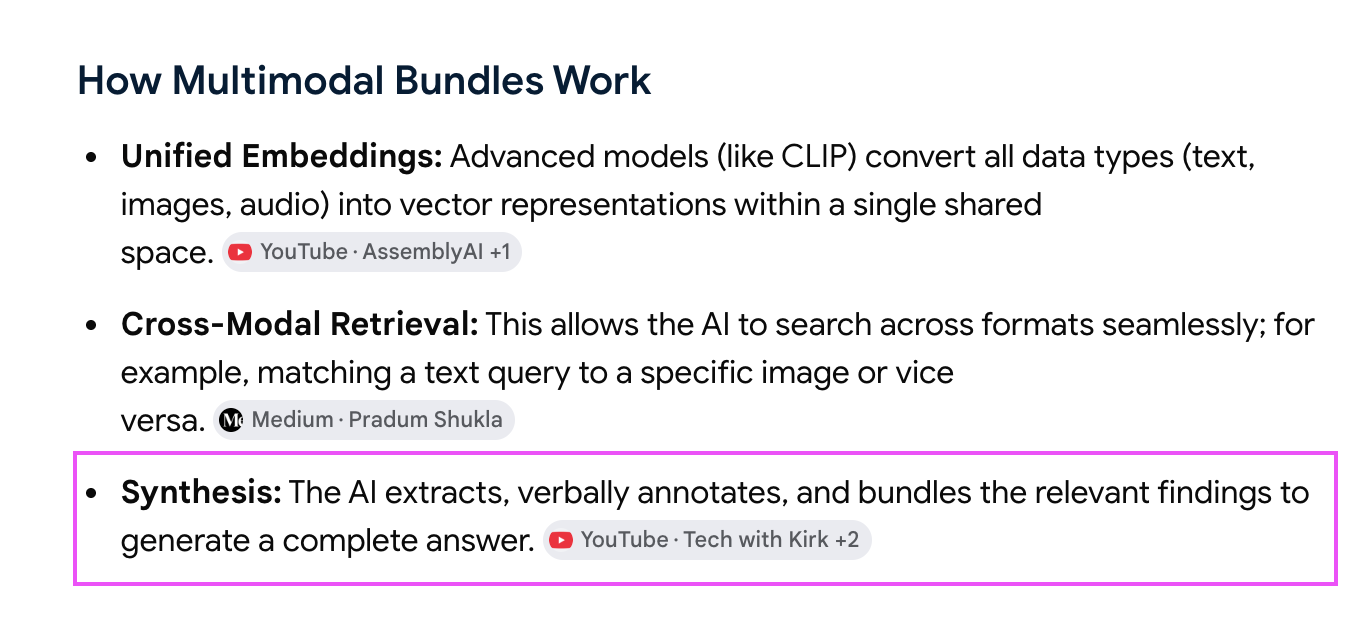
- Multimodal bundles: The ability of AI engines to process images, text, video and audio is called multimodality. Multimodal bundles are best exemplified by YouTube videos (cited in nearly 30% of AIOs), but you can achieve them on your blogs too. They incorporate multiple content formats containing the same message, allowing AI to extract from whichever format is easiest.
- Rich media: Embed rich media like interactive location maps, infographics, explanatory short videos or a chart to make the page clearer and more scannable.
The best way to understand the difference between multimodal bundles and rich media is illustrated by the AI Overview for the search query “What are multimodal bundles in AI search?”
Sure enough, YouTube made the cut by leveraging multimodality, while the referenced Medium article contains rich media, including multiple infographics pulled from other sources, an embedded video and code examples. Voilá.
4 Strategies To Improve Your Website for AIO
Your content should be looking pretty good by now. But, as you know, nobody wins AI citations from a single page’s success: You’ve got to standardize your practice across your entire website.
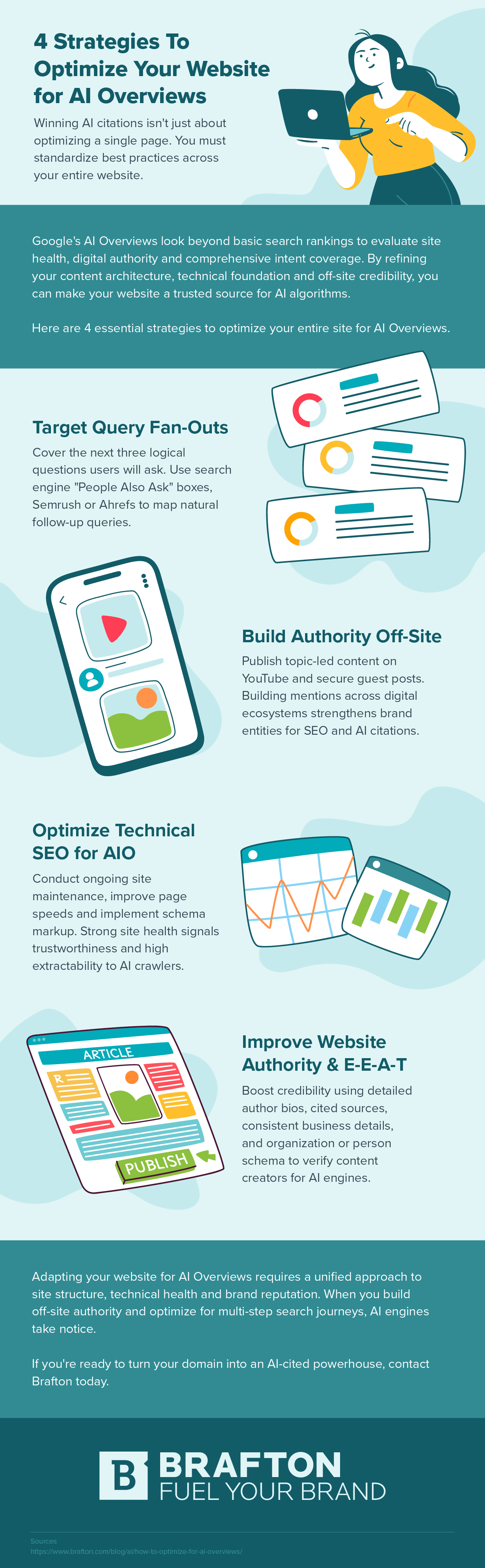
1. Target Query Fan-Outs
Ensure your pillar pages explicitly answer the next three logical questions a user would ask. If you’re stuck for ideas, the People Also Ask section of the search engine results page shows common user queries, and both Semrush and Ahrefs have AI query fan-out tools.
2. Build Authority Off-Site
Phil encourages publishing topic-led content across YouTube and guest posting to build up authority throughout digital ecosystems. They’ll earn you brand entity mentions, which are great for the search trifecta: SEO rankings, AIO and LLM citations.
3. Technical SEO Considerations for AIO
Maintaining your site’s health still requires ongoing reviews, maintenance and updates. No snoozing on page speeds, schema markup and strategy developments. These all contribute to your website’s performance and user experience, which search engines and AI crawlers read as a trustworthy, extractable site.
4. Improve Website Authority for AI-Generated Features
Credibility signals, like detailed author bios, cited sources and consistent business information across your site, strengthen your E-E-A-T. Add organization and person schema so AI systems can verify who’s behind your content.
Ready, Get Set, AIO!
Love it or hate it, AI is changing the way we search for information — and that means we need to adapt to stay competitive. Despite the deeper competitive and strategic shifts, the changes required for your content are not that different from how we’ve adapted for featured snippets, the rise of localized SEO and other major algorithmic shifts.
Having been through a wave of SEO changes across content management and production, my money’s on this not being the last of the major reforms we move through.