

No matter your stance on AI, reports abound with figures showing that most organizations and departments — especially marketing — have not only adopted the technology but continue to use it.
Brafton’s second annual State of AI in Marketing Teams report is among those that show that reality. In our case, 81% of 163 surveyed marketers said “Yes” to using AI — 62% of whom indicated they significantly increased their use over the previous year.
But what about that remaining 19 percent? That’s about 30 folks in our sample who are holding out on AI. All things considered, that feels like a relatively large group when, no matter where you turn, it seems as though AI has encroached on everything, everywhere.
Let’s look at who these marketers are, the reasons for their resistance, and how they really feel about the future of AI and our industry. Some responses may surprise you.

The Firmographics: Who Isn’t Using AI?
A majority of those for whom AI still eludes, willfully or not, never began to use it in the first place.
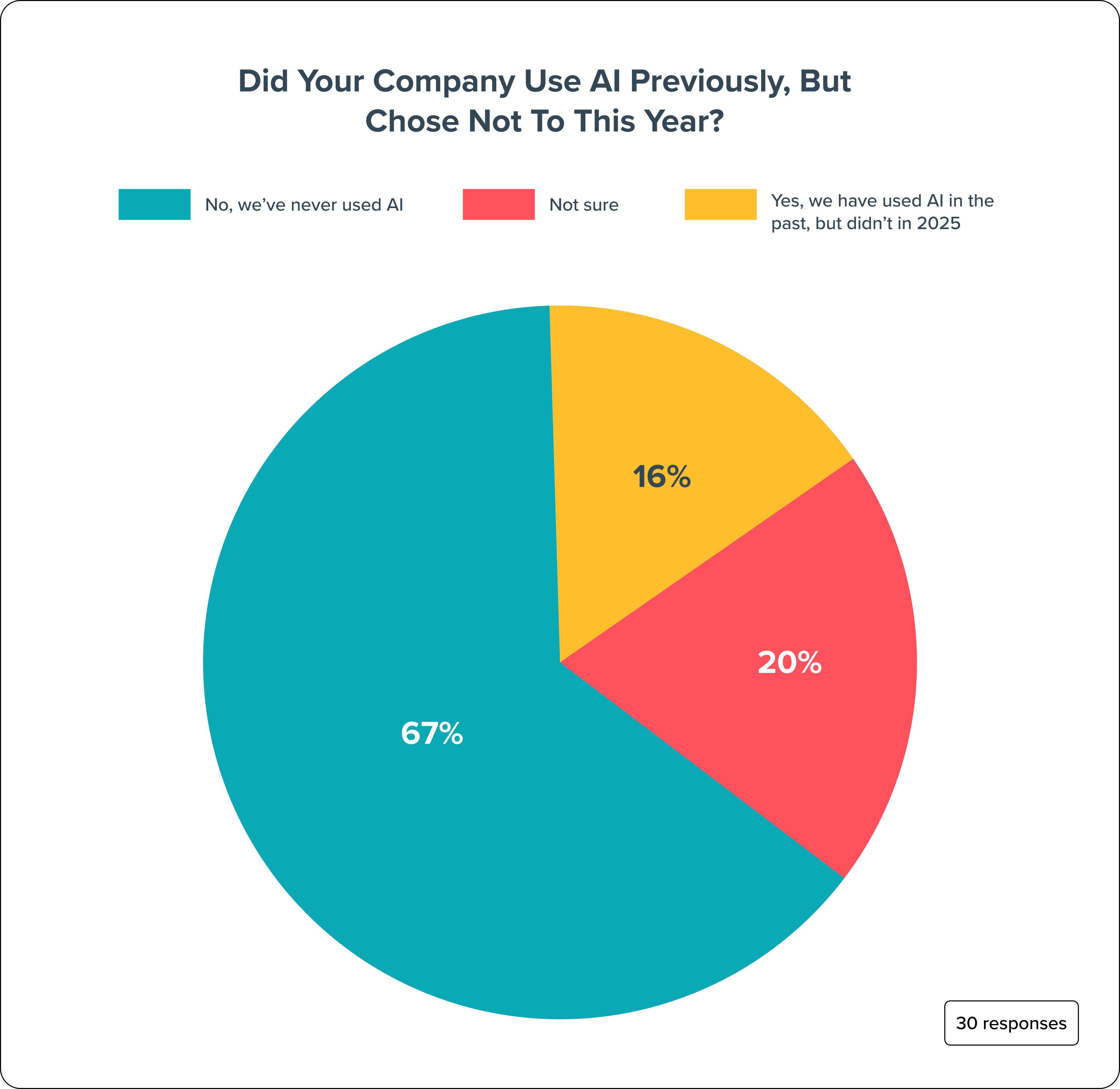
Of the 30 total respondents who said they didn’t use AI in 2025, 63% say they’ve never used it at all, while 17% indicated that, while they might have used AI previously, they chose not to in 2025.
AI Non-Users by Industry
Industries most represented in the former category (have never used AI) are:
- Nonprofit & social services: 16.27%
- Software & SaaS: 13.33%
- Health & wellness: 10%
- E-commerce, retail & distribution: 10%
To see nonprofit and social services at the top is not surprising. Humanity is the core of businesses operating in those sectors, and AI would only serve to get in the way of that.
Here’s what one respondent working in the industry had to say:
“AI ‘slop’ is getting a fairly negative reaction from the voluntary and community sector — especially one that works quite closely with artists, poets and writers. With AI continually plagiarising work, and including vast amounts of information that it has taken without permission, it becomes quite difficult to use AI in a way that is ethical.”
Our sample for the latter category (have used AI previously, but not in 2025) is far smaller, but includes marketers working in:
- Ecommerce, retail & distribution.
- Health & wellness.
- Real estate.
- Software & SaaS.
- Technology & IT.
Subscribe to
The Content Marketer
Get weekly insights, advice and opinions about all things digital marketing.
Thanks for subscribing! Keep an eye out for a Welcome email from us shortly. If you don’t see it come through, check your spam folder and mark the email as “not spam.”
AI Non-Users by Company Size
In our sample, large businesses with between 51–500 employees were the most likely to not actively be using AI:
- Small business (1–20 employees): 30%
- Medium business (21–50 employees): 20%
- Large business (51–500 employees): 40%
- Enterprise (501+ employees): 10%
Without looking at any data, it’s tempting to assume that AI resistance is concentrated among smaller organizations with fewer resources. But these figures suggest otherwise.
More than half of AI non-users work at large companies with 51–500 employees. While our sample is relatively small, it suggests that choosing not to adopt AI isn’t exclusively a resource problem. In many cases, it appears to be a deliberate organizational decision rather than simply a lack of budget or technical capability.
AI Non-Users by Region
While North America accounts for most AI non-users in our survey, that’s largely reflective of our overall respondent base:
- North America: 64.52%
- Asia Pacific: 12.90%
- United Kingdom: 12.90%
Why Some Companies Aren’t Using AI
The reasons that some marketers and organizations are turning away from AI are quite diverse, and for some, even a little unsure. 17% of respondents who told us they aren’t using AI weren’t quite sure why. Perhaps they never saw the tech’s potential or value for their workflows, don’t care to learn a new technology, or simply just don’t know why their companies haven’t adopted it.
Most respondents, however, had clear reasons why AI wasn’t a part of their martech stacks:
- Moral, ethical and/or environmental concerns: 48%
- Lack of confidence in the quality of AI output: 35%
- Data privacy concerns: 30%
- Current AI tools don’t meet our needs: 22%
- Unsure: 17%
- Lack of budget for AI tools: 13%
- Lack of training/expertise in AI systems: 13%
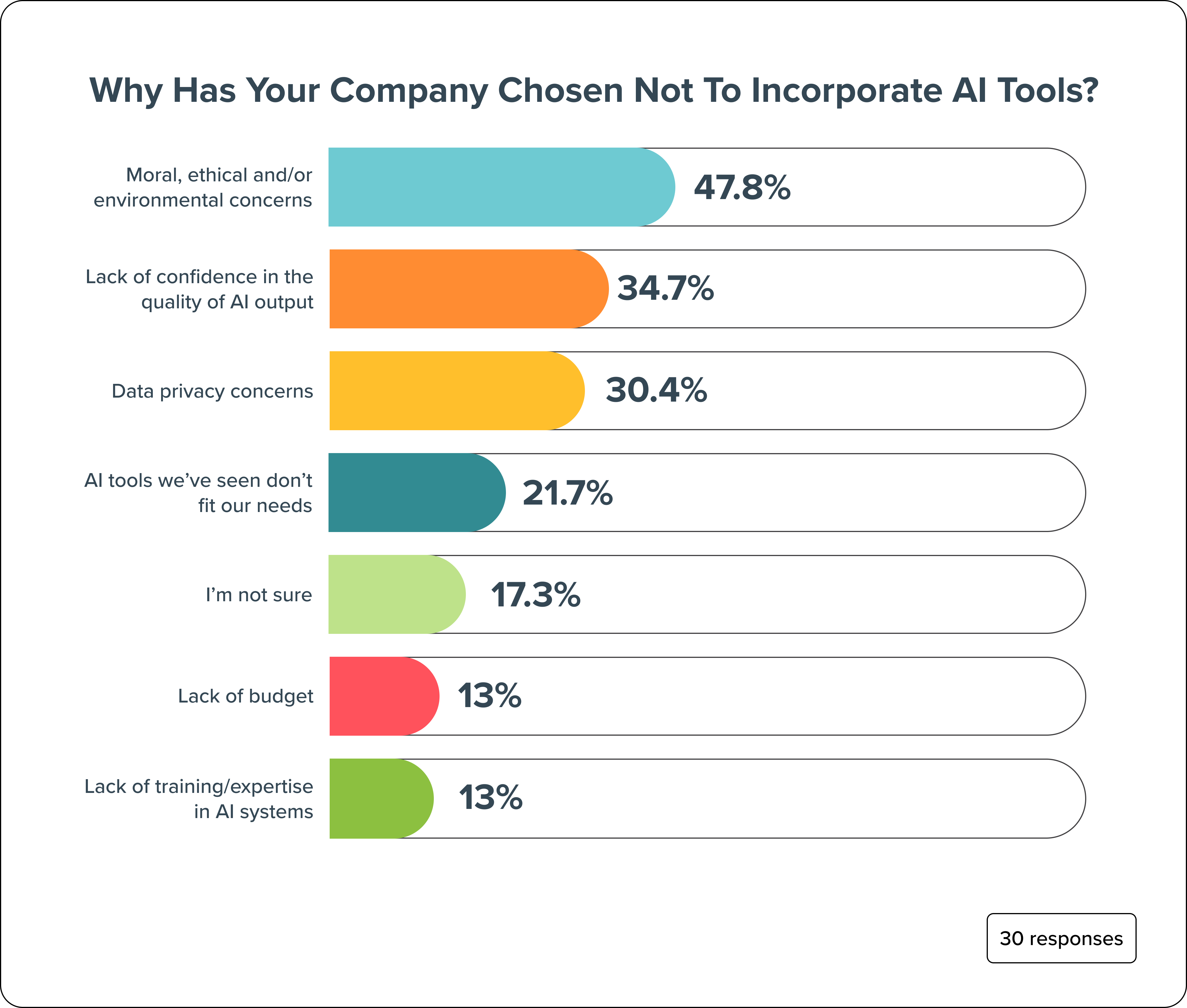
The top four concerns are, in some sense, willful acts; more or less intentional. These marketers and organizations are intentionally choosing not to use AI — whether because of moral and environmental concerns, low confidence, data privacy risks or poor strategic fit.
There’s a contrast between these concerns and the ones marketers had in last year’s white paper. Mind you, there’s also a wide gap in sample size for this specific question between the two reports. Last year, just 5 respondents chose to tell us why they weren’t using AI, compared to 30 here.
Still, the comparison provides an interesting view of how marketers’ concerns have changed over the course of a year.
Last time, data privacy concerns topped the list, and energy use/environmental impact ranked 4th. But this time, marketers’ personal values and concern for the environment shot up to No. 1. Considering the rapid development of sprawling new data centers, I understand why concern has grown here.
Do You Have Plans To Adopt AI This Year (2026)?
We also asked marketers whose organizations haven’t implemented AI yet if they plan to in 2026. Here’s what we heard:
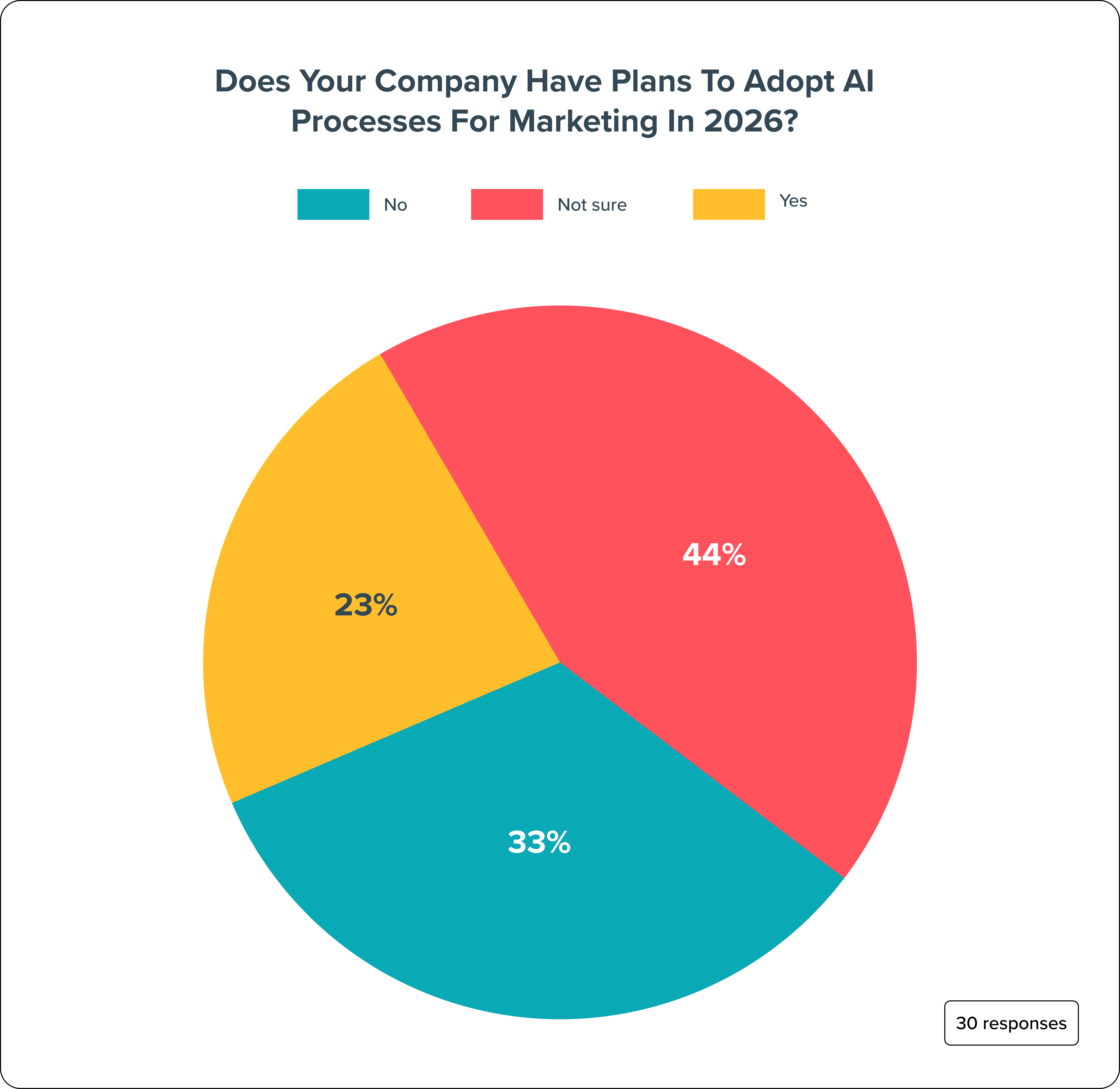
- Yes: 23%
- No: 33%
- Unsure: 43%
This bit of data is interesting. Yes, one-third of marketers have no plans to adopt AI this year, which seems pretty resolute. But nearly half remain undecided.
That suggests many organizations may not be firmly opposed to AI and could simply be waiting for better tools or governance, or answers around ethics, privacy or return on investment. As AI adoption matures, many businesses are evaluating AI agent platforms that combine governance, security, integrations and workflow automation into a single environment instead of relying on disconnected AI tools.
Of course, it may also be true that these folks simply don’t have insight into what the decision-makers at their companies plan to do at the organizational level.
I’m curious to see how these figures might change in our planned third edition of this report.
Marketers Who Aren’t Using AI: Their Takes on the Tech & the Future
Marketers on both sides of the fence — those currently using AI vs. not using AI — have mixed feelings about its future.
Some marketers who are actively using AI, for example, don’t feel good about it, while others who aren’t using it are still optimistic about the tech and its role in our work and lives. The opposite is true as well, of course: There are folks actively using AI who feel good about it and its future, and those who are not using AI and are more pessimistic.
But let’s focus on those who indicated that they’re not actively using AI. Here are some of those respondents’ perspectives and outlooks.
On AI reliability and desirability:
“I don’t think generative and agentic AI tools will become much more reliable or desirable than they currently are. There is a ceiling of AI adoption in marketing, and we’re about there already.”
On AI inevitability:
“I am not enthusiastic about it in the slightest. We are living in a world where there is no way around AI usage, but it is imperative we do not replace the human elements of art, media, and communication with artificial intelligence.”
Accepting AI’s inevitability doesn’t always translate into enthusiasm. Several respondents acknowledged AI is here to stay while simultaneously advocating for careful limits on where, and whether, we should use it.
On usefulness and personal choice:
“Probably can be a useful tool to enhance human marketing and undoubtedly will become increasingly used, but never by my firm.”
On inevitability and cautious use:
“It’s here and not going away. I want to use it cautiously.”
On preference:
“I can see how it can be helpful, but I prefer to see human-generated content. I scroll past all AI in every situation.”
This is perhaps one of the more personal responses we received. Rather than objecting to AI on principle, this respondent simply prefers human-created work and acts on that preference as a consumer.
On environmentalism and creativity:
“Grim. I think that what is gained in efficiency is not close to worth it for what we are losing environmentally and it’s creatively bankrupt.”
For some marketers, the debate extends far beyond productivity. Concerns around creativity, environmental impact and the value of human work continue to outweigh any efficiency gains AI might offer.
On priorities and humanity:
“It indicates that we value productivity over all other things — over human expression, creation, and connection. I detest it.”
On the market and AI’s fate:
“It’s saturating the market, and will eventually weed out.”
On AI’s potential:
“Huge potential.”
Pretty straightforward; even though this marketer isn’t using AI, they seem excited about its potential future capabilities.
On benefits and content integrity:
“I think it can be beneficial to get a starting point for designs and messaging but the human element still needs to be maintained for accuracy and quality assurance.”
These quotes help illustrate the reality of marketers’ diverse opinions. AI non-users aren’t a monolith. Some are optimistic, some are skeptical and some are conflicted. Many recognize AI’s potential while remaining cautious about its impact on creativity, quality or ethics. Their perspectives add an important layer of nuance to an industry conversation that’s commonly framed as adoption versus resistance.
Final Thoughts
It’s easy to look at an 81% adoption rate and conclude that AI has become a settled question in marketing. I mean, most all other external signals certainly make it feel that way. But our survey suggests otherwise.
While most marketers are embracing AI in some capacity, the remaining 19% remind us that adoption isn’t simply a matter of keeping up with technology. For many organizations, the decision is rooted in trust, privacy, creative philosophy or strategic fit.
What’s perhaps most striking is that many non-users don’t deny AI’s capabilities or even its inevitability. Instead, they’re wrestling with what widespread adoption means for their organizations, their industries and the people behind the work.
Whether those concerns fade or intensify over the coming years remains to be seen. But understanding why some marketers are still choosing not to use AI provides valuable context for an industry that’s often portrayed as moving in only one direction.
Check out our other blogs that dive deeper into other sections of our latest report: