

Convincing leadership to invest in something new isn’t always easy, especially when the results are difficult to predict or measure. Generative engine optimization (GEO) presents exactly that challenge.
Marketers increasingly recognize the importance of visibility in AI-powered search experiences, but getting everyone in the organization on the same page takes work. Leadership may question whether GEO deserves attention alongside established marketing priorities, particularly when budgets and resources are already stretched.
Interestingly, our research found that leadership skepticism was one of the least common barriers to GEO adoption. That’s encouraging, but it doesn’t make the challenge any less frustrating for marketers who are struggling to get support.
The good news? You don’t need to convince your boss to overhaul your entire marketing strategy. A stronger case for GEO starts with showing how AI search fits into the customer journey, identifying opportunities within your existing efforts and demonstrating what your organization stands to gain.
Here’s how to approach that conversation.
Subscribe to
The Content Marketer
Get weekly insights, advice and opinions about all things digital marketing.
Thanks for subscribing! Keep an eye out for a Welcome email from us shortly. If you don’t see it come through, check your spam folder and mark the email as “not spam.”
What Our Research Reveals About Leadership Buy-In for GEO
Getting leadership on board isn’t necessarily the biggest challenge marketers face when implementing GEO. In our survey of 142 respondents, 15.49% cited leadership skepticism as a barrier, the least frequently selected option.
Other challenges were considerably more common:
- 50% identified competing priorities.
- 50% reported measurement challenges.
- 47.18% cited a lack of clear best practices.
- 37.32% identified limited internal expertise.
- 30.99% reported budget constraints.
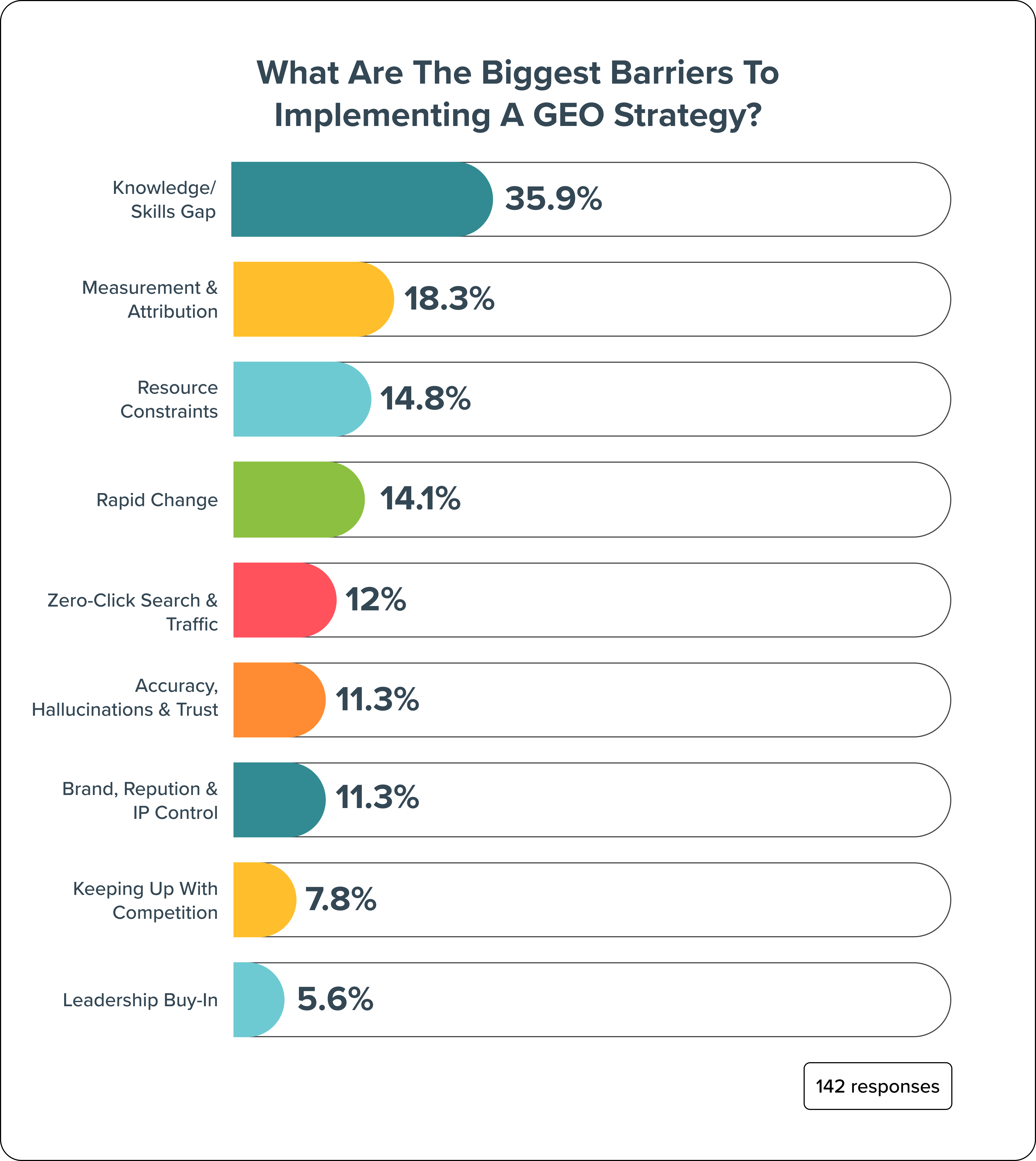
Another survey question explored respondents’ biggest concerns about generative search. Just 5.63% raised leadership buy-in, compared with 35.92% who identified knowledge and skills gaps and 18.31% who mentioned measurement and attribution.
Those percentages might seem encouraging. However, the open-ended responses reveal why executive support still matters.
One respondent worried: “That we will miss the opportunity to gain authority with the ‘wait and see’ attitude of leadership.”
Another identified: “Leadership skepticism (which of course impacts budget and implementation timetables).”
A third summed up their concern: “That our leadership won’t prioritize it.”
These comments capture a familiar frustration: Recognizing an opportunity but struggling to get the organization moving.
You can explore the complete findings in our How Are Marketers Handling GEO? survey whitepaper.
For marketers facing leadership resistance, the challenge is turning that concern into a business case executives can evaluate.
1. Show How AI Search Is Changing the Customer Journey
The first step is demonstrating that generative search is becoming part of how people research products, compare options and discover brands. A 2025 Pew Research Center analysis found that Google users clicked traditional search results in 8% of visits when an AI summary appeared, compared with 15% when no summary was present.
This finding doesn’t establish that AI summaries caused every difference in clicking behavior, but it illustrates how search experiences are evolving. There’s evidence of AI influencing shopping journeys, too. Traffic from generative AI tools to U.S. retail websites increased by 693.4% in 2024 and during the 2025 holiday shopping season, according to Adobe Analytics.
AI referrals still represented a relatively modest share of traffic, but the growth suggests these platforms are becoming another way consumers discover products.
For leadership, the bigger consideration is how these changes could affect the way customers discover and evaluate your business. If potential buyers are turning to AI tools for recommendations, comparisons and research, your brand needs to be part of that conversation.
Use this research as a starting point, then look at your own customer journey. Think about the questions buyers ask before contacting sales, the information they need to compare solutions and where AI-generated responses might influence their decisions. Connecting those behaviors to your business can help leadership understand why GEO deserves attention.
2. Bring Your Own Audience Data to the Conversation
Industry research can help get leadership’s attention, but your own data makes the case more relevant to your business.
Start by checking Google Analytics 4 for referral traffic from AI platforms like ChatGPT and Perplexity. Are these visitors engaging with your content, requesting demos or generating leads? Even modest traffic can be meaningful if it’s bringing in potential customers.
Keep in mind that referral data only tells part of the story. Someone might discover your brand through AI search and visit your website through another channel later. You can also test questions your customers might ask AI tools when researching products or comparing vendors. See which brands appear, what information is referenced and where your company fits in.
Together, these insights can help leadership see how AI search is influencing customer discovery and where GEO might create opportunities.
3. Start Measuring GEO Before You’re Asked for Results
It’s easier to get leadership on board when you can show how you’ll measure success. In our survey, 50% of respondents said measurement was a barrier to GEO adoption, while 31.69% weren’t sure how to measure AI search visibility and 23.24% weren’t measuring it at all.
You don’t need expensive tools to get started. Choose a handful of search prompts relevant to your business and track how often your brand and competitors appear in AI-generated responses. Record your findings regularly to establish a baseline, identify opportunities and give leadership something concrete to evaluate.
Useful starting metrics include:
- Brand mentions and citations in AI-generated responses.
- Competitor visibility for relevant prompts.
- Referral traffic from identifiable AI platforms.
- Engagement and conversions associated with those referrals.
- Changes in visibility following content improvements.
AI-generated answers vary, and a citation doesn’t automatically translate into a visit or conversion. Still, consistent measurement can help establish a baseline and identify opportunities worth investigating. Instead of asking leadership to invest based on predictions, you’ll have evidence of what’s happening today.
4. Explain That GEO Builds on Your Existing SEO Strategy
If your boss hears “GEO” and immediately imagines another expensive marketing program, there’s an important point worth making. Many established SEO practices also support visibility in AI-powered search.
Google’s official guidance on AI search features confirms that traditional SEO best practices remain relevant for AI Overviews and AI Mode. These include making content accessible to search engines, maintaining useful internal links, providing a good page experience and publishing helpful, reliable information.
Rather than proposing a complete overhaul, identify improvements that can benefit your existing SEO program while supporting AI search visibility. You might update outdated content, improve important product pages, strengthen internal linking or address technical issues affecting crawlability. Consider whether your content answers the questions customers ask, particularly when they’re researching solutions or comparing options.
These improvements have value beyond GEO, making them easier to justify within established marketing priorities. No optimization guarantees inclusion in AI-generated responses. Preparing for AI search doesn’t mean abandoning what already works.
5. Show How Internal Expertise Can Support Multiple Business Goals
Your company already has valuable resources that competitors can’t easily replicate: its people. Think about the knowledge sitting across your sales, product, customer service and technical teams. They understand customer challenges, recurring questions and the details that influence purchasing decisions. Bringing that expertise into your content can help create resources that offer more than generic information.
Our survey suggests marketers are recognizing this opportunity. 43.66% reported prioritizing more expert-driven content, while 41.55% indicated a shift toward higher-authority content. That might involve interviewing subject matter experts, publishing original research, developing comparison guides or answering complicated customer questions.
And the benefits of this extend beyond search visibility. Expert-led resources can support SEO, contribute to brand authority and give sales teams useful material to share during customer conversations. They can also help buyers evaluate solutions during the consideration stage, even if they aren’t ready to speak with sales.
For leadership, that’s a more compelling proposition than creating content solely hoping to appear in an AI-generated answer.
6. Give Leadership a Practical Starting Point
Even with supporting evidence, executives may hesitate to approve a major GEO initiative. That’s reasonable. AI search continues to evolve, measurement practices are developing and the return on individual optimization efforts can be difficult to isolate.
Rather than proposing a sweeping transformation, recommend a focused pilot. Choose a priority product, service or audience segment. Identify relevant customer questions, review existing content and make improvements based on the opportunities you find. Then, monitor what happens.
Your proposal should explain what the team will do, which resources it needs, how progress will be measured and when leadership can expect an update. Keep the objectives realistic. A pilot may uncover opportunities worth pursuing, or it may reveal that additional investment isn’t yet justified.
Either outcome helps the organization make a more informed decision.
Convincing Your Boss Starts With Making GEO Relevant
Our Brafton Labs research suggests leadership skepticism isn’t among the most widespread barriers to GEO adoption, but for marketers dealing with it, the challenge is real.
The answer isn’t to overwhelm executives with AI predictions or insist that every competitor is already miles ahead. It’s to connect GEO to the questions leadership already cares about. How are customers finding us? Where might we be missing opportunities? What can we improve with our existing resources? How will we know whether an investment is worthwhile?
Start with credible research. Bring your own audience data into the discussion. Establish a measurement process and identify improvements that support both SEO and AI search. Then propose a practical next step.
You might not convince your boss to make GEO a top priority overnight. You can, however, give leadership a much stronger reason to take it seriously.