

Artificial intelligence (AI) has changed how we search.
Maybe you just look at the AI-generated answer atop the search engine results page (SERP) and move on. Maybe you detest it so much you turn the function off. Or maybe you’re somewhere in between. Regardless, searching on the internet is markedly different from how it was 3 years ago.
And have these changes actually made it easier to find information? That’s a debate for another time. What we can say definitively is that these changes have left many marketers with more questions than answers.
At Brafton, we’re never afraid of change or to ask the hard questions. That’s why we conducted a survey about generative engine optimization (GEO). We polled 142 industry professionals on how they’re adapting to search in the age of AI.
While there are many nuances within the responses we received, one general truth emerged. Even though GEO adoption is underway, marketers harbor significant anxieties about the shift. When asked about their biggest concern regarding generative search, only 6% didn’t have an answer. Everyone else could name something that worried or bothered them.
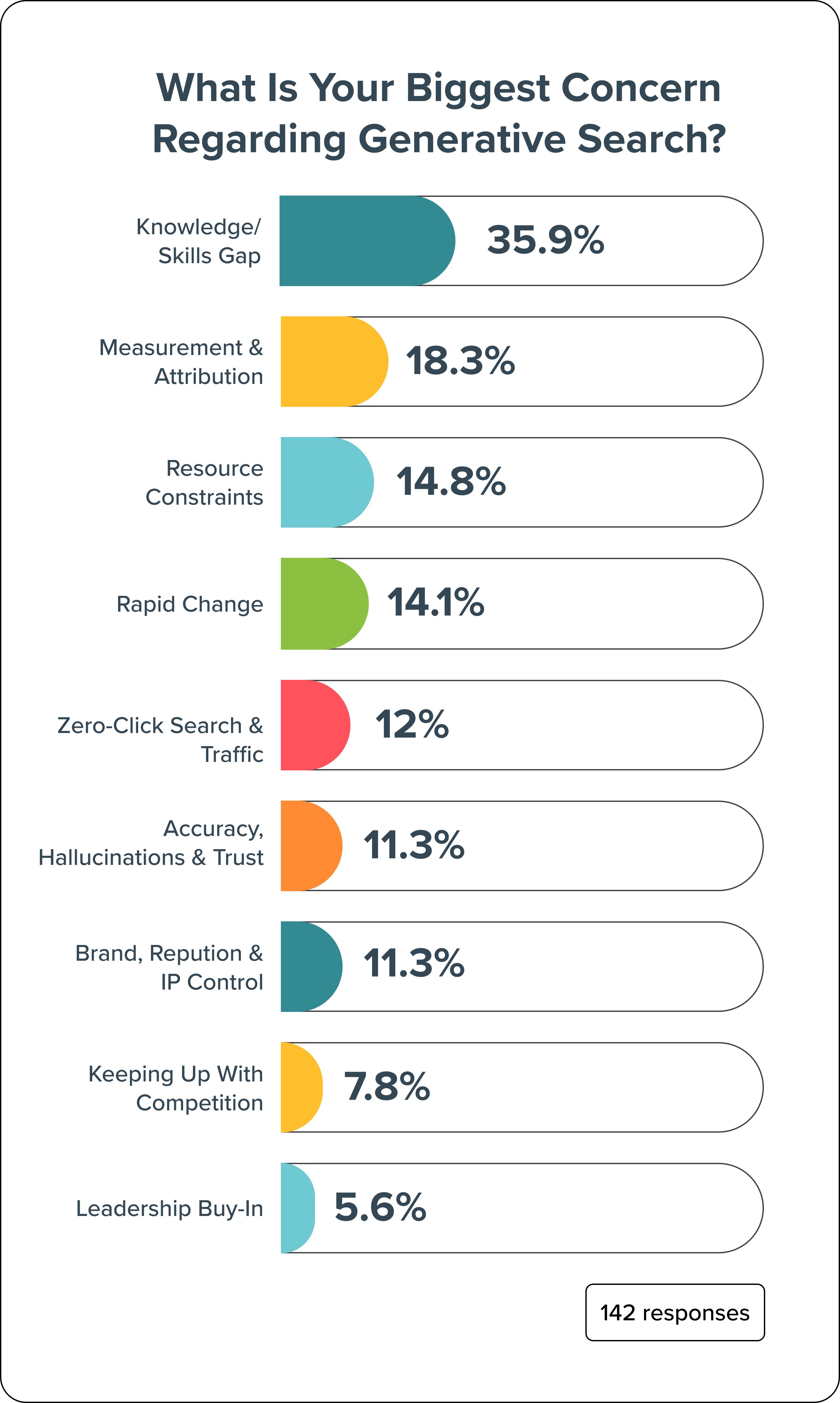
Today, we’ll look at the distinct concerns voiced by the other 94% of respondents. And if you want to read our full white paper on the survey, you can do so here.

1. The Knowledge/Skills Gap
At 36%, this was the top concern among those surveyed. And that makes sense. GEO is an emerging discipline based on relatively new — and constantly changing — technology. Just when you learn how one aspect of GEO works, there may be something else to grapple with. And the worry that a competitor knows something you don’t can be very unnerving.
Our survey solicited responses from marketing managers and directors (about 67% of all respondents), CEOs and executives (~18%) and individual contributors (~15%). Uncertainty about this brave new world of GEO can apply to people in roles up and down an organization.
This is a new game, and we’re all still learning the rules. It’s like the first few tentative rounds of a board game. The more we see how it’s played, the more we’ll all get a little more comfortable.
To help you get there, we’re publishing an article specifically addressing how to close this gap very soon.
Subscribe to
The Content Marketer
Get weekly insights, advice and opinions about all things digital marketing.
Thanks for subscribing! Keep an eye out for a Welcome email from us shortly. If you don’t see it come through, check your spam folder and mark the email as “not spam.”
2. Measurement & Attribution
Nearly 1 in 5 respondents (18.31%) named measurement and attribution as their primary concern. And it speaks to an underlying tension that’s ever-present in marketing: Just how closely correlated is marketing with revenue? Do increased sales reflect an improved product or an effective marketing campaign?
The answer is often “both,” but figuring out the correct level of attribution is difficult. There are several reasons a product or service may sell in high or low numbers that have nothing to do with marketing. That’s why marketers use metrics that more closely reflect the efficacy of their efforts. These range from focus group feedback to click-through rates to website traffic.
As GEO is relatively new, it’s difficult for many to understand the actual impact that AI search results have on a brand’s visibility and lead generation. How important is it for a company’s webpage to pop up in an AI-generated answer on a SERP? The answer is … it depends.
Every case is different. Maybe someone interested in travel asks their preferred search engine or large language model (LLM) when the best time to visit Japan is. If the AI answer cites a cruise ship company, there’s a chance they book a trip with that company.
Or maybe somebody wants to know what a mutual fund is. They may see an investment firm referenced in the AI answer. They may or may not even visit that page to learn more. But if the person is just searching out of curiosity, they’re unlikely to start investing with that firm today.
That doesn’t mean there’s no value to that investment firm. It establishes them as a thought leader in their field. When that searcher is ready to start investing in two years, maybe they think of that firm. It’s hard to say.
3. Resource Constraints
Nearly 15% of respondents highlighted resource limitations. They could be referring to limited funds, lacking personnel, not having the right tools or some combination of all three. This is totally valid, but it’s worth remembering that this concern is applicable to any new technology or campaign.
And this relates to the previous section. If marketers struggle to find the internal capacity and financial backing to properly invest in their GEO efforts, they may appeal to leadership for a larger budget. If they can’t present a strong case for ROI, they may not get the budget they want.
We wrote in detail how brands are dedicating GEO budgets right now, and how marketers without a GEO budget can start to build an AI visibility strategy anyway. Check that out here: How GEO Budgets Influence Strategy.
4. Rapid Change
Change is often scary, especially when it happens fast. And AI seems to be advancing at breakneck speed.
That’s why 14.08% listed the sheer pace of AI evolution as their primary concern. As a discipline, GEO appeared quickly, and it’s changing so fast that it leaves some marketers’ heads spinning. And there’s always the worry that a marketer or their team may learn one approach to GEO that becomes outdated soon after.
While these feelings are entirely understandable, they may not justify avoiding GEO practices or waiting for the practice to evolve. While the technology is changing, it’s mostly building upon itself rather than completely rewriting the core rules of search.
5. Zero-Click Search & Traffic
This relates to the “Measurement & Attribution” worry, but these 11.97% of respondents were more precise in voicing their concern. The apprehension stems from the idea of AI Overviews and other generative search surfaces “stealing” direct traffic away from brand websites.
Take the aforementioned example of a person searching “What is a mutual fund?” If they really just wanted to know what it is, they may simply read the AI snippet and move on with their day. If we truly are transitioning from a click-based search ecosystem to an answer-based one, this will upset a lot of traditional digital marketing strategies.
It’s impossible to say just how significant or permanent this shift may be. As people learn more about AI, they may choose to click on its sources more often to verify its answers. Furthermore, marketers may focus their efforts more on search terms that are likelier to result in clicks than just surface-level informational queries.
6. Accuracy, Hallucinations & Trust
A similar number of respondents (11.27%) are concerned about AI getting the facts wrong. Which is a fairly well-founded fear.
AI hallucinations are a known problem. Brands may worry that AI summaries don’t accurately reflect the information they publish. Others may suspect that people might turn away from artificially generated answers as AI as a concept could become less popular in the public consciousness.
Perhaps the best answer here is to write as clearly as possible to reduce the chances of AI misunderstanding or misrepresenting the information. This also speaks to the value of pursuing other facets of digital marketing, such as email newsletters, social media marketing and search engine optimization (SEO) efforts.
7. Brand, Reputation & IP Control
This actually tied with the previous response. Concerns over intellectual property and brand image are very real.
Even if AI accurately represents the facts you publish on your company blog, there’s no guarantee that AI will convey the information in a way that comports with your brand image and tone. Furthermore, LLMs may scrape your website for information and not properly cite what they take. This is an ongoing and open debate regarding AI.
8. Keeping Up With Competition
The fear of missing out is always hanging around. For 7.75% of respondents, it’s clearly a top-of-mind concern. GEO is so new, and there are so many questions that some might choose to wait to see how the technology unfolds. But doing that may mean watching competitors adapt to GEO while your own brand is stuck in this “wait and see” phase.
Jumping into GEO without a plan would be unwise. But sitting back and doing nothing carries its own risks.
9. Leadership Buy-In
Support from executives may be a problem, but it’s apparently the least common problem, with only 5.63% citing it as their biggest concern. Nonetheless, it’s potentially a big one.
If a company’s leadership doesn’t care about GEO, it will hold its marketing teams back. Executives ultimately dictate budgets and overall priorities. If marketers can’t get them on board, they won’t have the resources they need to succeed with their GEO plans.
What Does It All Mean?
We’ve looked at 9 distinct concerns today. They’re varied, but they all stem from the growing pains of a massive industry shift. Some worries reflect long-standing marketing questions — “Will this actually deliver ROI?” Others reflect the newness of GEO — “Does this actually matter?”
Respondents voiced concerns that reflect the consequences of doing nothing and doing too much in this new and unfamiliar landscape. Learning more about GEO can help. If you’d like to do some more research, you can start by reading our full whitepaper: How Are Marketers Handling GEO?