

Nothing irritates an editor more than conflating content editing with copyediting. In fact, when you’re collaborating with a content professional, it’s essential to acknowledge the difference editing can make, especially when comparing the duties assigned for editing content and those that are more focused on copyediting responsibilities.
Every editing service, whether it involves blogs, social media posts, newsletters or full book editing projects, must address the distinct roles of content editing and copyediting to properly maintain brand quality and consistency. It’s critical to understand how these two facets of the larger research, writing and editing process help you avoid pitfalls and errors, empowering you to produce polished writing that aligns with your brand style every time.
So, in the spirit of ensuring we have fewer ticked off editors out there, it’s time to learn more about the clear distinction: content editing vs. copyediting. This piece will shed light on everything involved in making sure that all the blogs, newsletters and social media posts you put out into the world are up to your brand standards.
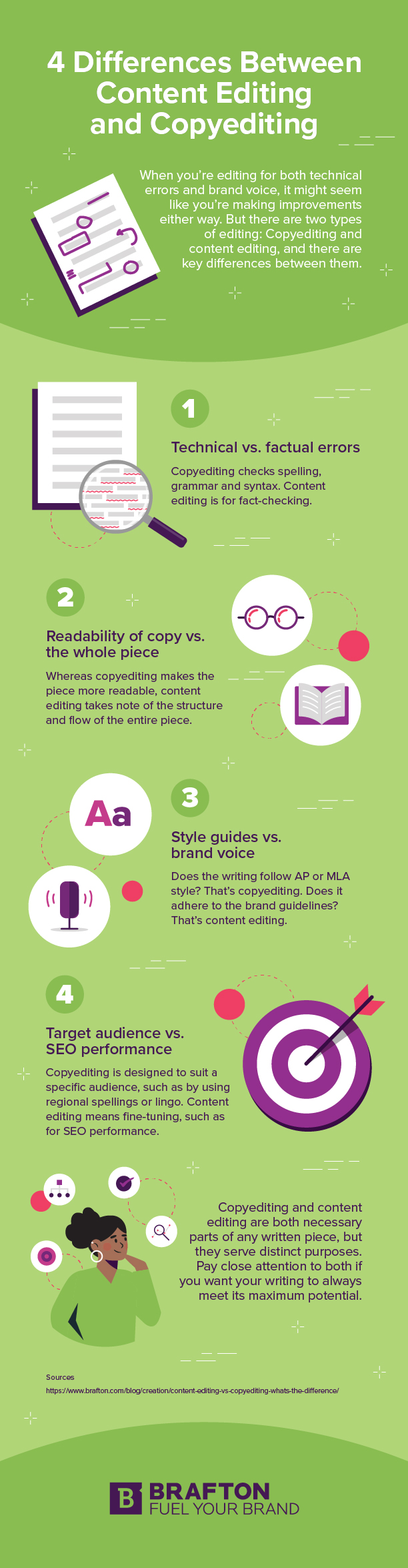
While the question of content editing vs. copyediting may seem like we’re splitting hairs, I promise: There is a distinct difference between the two. Understanding the nuances of both can help you clean up your copy and avoid publishing embarrassing content blunders.
With the right editing approach, you can achieve high-quality and compelling content that serves all of your various content marketing objectives. Let’s get straight into it!
Start at the Surface: Copyediting
Copyediting can be thought of as the first layer of editing: It encompasses tasks like checking for grammar, spelling and regional differences in language. While we may consider that to be surface-level stuff, that doesn’t make copyediting any less important.
Simple spelling errors, awkward phrasing and grammar mistakes reflect poorly on a brand. How will audiences take your message seriously if it’s presented with the same care and attention to detail as a 7th-grade research paper on the Roaring Twenties?
What we’re really getting at with copyediting is the language used in your content. Does it follow the rules of grammar? Is the choice of sentence structure on point? Are there glaring errors in the copy that would make even your always-proud grandmother a little embarrassed on your behalf?
With every writing and editing project, it’s crucial to handle these basics first before moving on to bigger-picture concerns.
What Copyediting Entails
When a copyeditor sits down to review an article, white paper, eBook or what have you, they’re on the lookout for a wide variety of issues that could impact the readability of the material as well as how that content presents the brand. Those include:
- Spelling errors.
- Punctuation.
- Capitalization.
- Sentence structure – i.e., syntax.
- Regional differences in language – American English vs. British English, for instance.
You could go even deeper with regional changes in spelling and vocabulary if your audience is hyper-localized to a specific metro area. For example, “jawn” is an entirely meaningless word in most of the English-speaking world. But any good copywriter would be remiss if they didn’t include it in content targeting a Philadelphian audience.
Copyediting also means checking that content adheres to any particular style guides. At Brafton, we usually follow AP Style, but we’ve been known to make exceptions when it serves the content or if specific AP rules contradict our clients’ own brand guidelines.
No matter which approach you follow, be it AP or the Chicago Manual of Style, a copyeditor can help maintain a consistent look and feel throughout the document.
A Knowledgeable Copyeditor Makes All the Difference
That may all sound very straightforward, and perhaps spellcheckers and word processing software will one day become sophisticated enough to obviate the need for a hands-on copyeditor. But that day ain’t today.
In truth, it takes a deft hand and a mindful editor to navigate all of the different grammar rules, style and tone types, bespoke client editing guidelines and nuances in language. The goal is always to fine-tune content so it’s pristine on a technical level and easily digestible to the target audience.
Copyeditors frequently need to decide between what is grammatically correct and what reads better to a specific audience. Many literary giants, including William Faulkner, James Joyce and F. Scott Fitzgerald, have used excessively lengthy or labyrinthine sentences in their writing. While grammatically sound run-on sentences may fly in “Ulysses,” they don’t really have a place in content marketing.
That doesn’t even account for the fact that language and grammar are constantly evolving. New words enter the lexicon, once-popular terms fall out of use and stuffy language gets cast aside even if it’s technically correct (I give “whom” another 30 years tops before it’s officially tossed into the dustbin of linguistic history).
So, yeah, you need an experienced editor with a sharp eye for details on your content marketing team. Could a machine, software or algorithm handle copyediting responsibilities? Maybe, but you probably wouldn’t want it to. That is, unless your brand identity is stuck in the 19th Century.
Subscribe to
The Content Marketer
Get weekly insights, advice and opinions about all things digital marketing.
Thanks for subscribing! Keep an eye out for a Welcome email from us shortly. If you don’t see it come through, check your spam folder and mark the email as “not spam.”
Digging Deeper Into Copy: Content Editing
We’ve already discussed grammar and punctuation; what else is there to do in the editing process? Oh, you sweet summer child. There’s so much more that goes into editing, proofreading and the complete content refining process. Once executed, you can rest assured your audience will remain engaged and well-informed.
So finally, content editing deals with both the creative and structural elements of a piece of writing.
Yes, copyediting covers a lot of ground and gets at the nuts and bolts of language and sentence structure. But after that’s done, you still need to dig into the meat of your content. That’s where content editing – sometimes referred to as developmental editing – comes in.
There are a few different components to content editing, ranging from the flow and structure of your content and the accuracy of the subject matter to brand voice and SEO-related items. Each is a key contributor to ensuring the piece is interesting, trustworthy and fits every requirement of your strategy.
Fact-Checking
Shocking as it may be, you can’t believe everything you read on the internet. Even major publications and news outlets misstate facts and get things wrong from time to time. While in theory, brand marketers don’t need to hold themselves to the same journalistic standards as The New York Times, preserving your brand’s integrity and authority is paramount.
The more sophisticated or knowledgeable your audience is, the more thorough your fact-checking needs to be. Which isn’t to say that you can phone it in when writing content targeting general consumers. The point is that a technical audience like IT workers will be far more likely to pick out inaccuracies in your content and call you on it than passionate subject matter enthusiasts.
It’s tough to build brand authority and thought leadership when your readers are constantly pointing out errors in your content, but you have to keep that reality in the back of your mind. All of this underscores the importance of knowing your audience really well so you can consistently win at substantive editing.
Structure and Flow
Wait, didn’t we already cover sentence structure? Yes, but while copyediting involves checking the syntax of your writing, content editing focuses on the structure of the entire piece of content. Do the arguments follow a logical progression? Do the talking points seamlessly segue from one to another? Is your content structured in such a way that the reader will be able to follow along without any difficulty?
Marketing collateral, even when it’s designed to be informative, educational, funny, engaging or all of the above, will always retain an inherently promotional element. The best content incorporates brand messaging in such an elegant and organic fashion that the audience may not even realize it’s there.
Whatever brand message underpins your content, it needs to be earned through persuasive arguments and talking points that are positioned at the exact right moments in a given article or blog post. How you structure your content can make all the difference between compelling material that wins over your audience and transparent sales collateral that drives people away.
In fact, the right type of editing and making precise editing considerations can help refine tone, narrative pacing and clarity at every stage.
Brand Voice and Tone
In a perfect world, each one of your copywriters would have your brand voice down pat, able to slip into that particular tone like it was second nature. Rarely is that the case. Plenty of writers will tell you that it’s difficult to completely turn off your inherent writing style in favor of another, and it’s true.
More nuanced or complex brand style guides often require multiple layers of editing to check that copy aligns with the brand voice. Slight changes in word choice or sentence structure can have a profound effect on the message you’re trying to convey, making an eagle-eyed content editor absolutely essential.
A good content editor needs to know your style guide (or your client’s) from front to back and how to apply those rules in different scenarios. Your brand guidelines may prefer active voice, but are there circumstances when passive voice is acceptable? It takes a discerning content editor to make those judgment calls accurately and quickly while keeping workflows running smoothly.
Search Engine Optimization (SEO)
Quality content alone won’t help your digital marketing strategy if you haven’t optimized your copy to rank for relevant search terms. You should be building all of your content around heavily researched keywords that closely reflect what people actually search for on Google.
Without on-page optimization, you’re basically just throwing words into the ether and hoping someone, somewhere, comes across them. Never mind if those people even represent your customer demographic.
Applications like Moz, MarketMuse and SEMrush can help your marketing team identify search terms that are relevant to both your business and your audience. MarketMuse can even act as an editing tool of sorts by analyzing written copy to check that it includes a wide variety of relevant topics. It’s the perfect assist, helping you pause, reassess and decisively implement effective ways to improve your writing depth.
By focusing on well-planned content editing and copyediting processes, you can align your outputs with clear SEO goals. And then you’re well on your way to seeing a greater return on your content marketing investment.
Recap: Content Editing vs. Copyediting
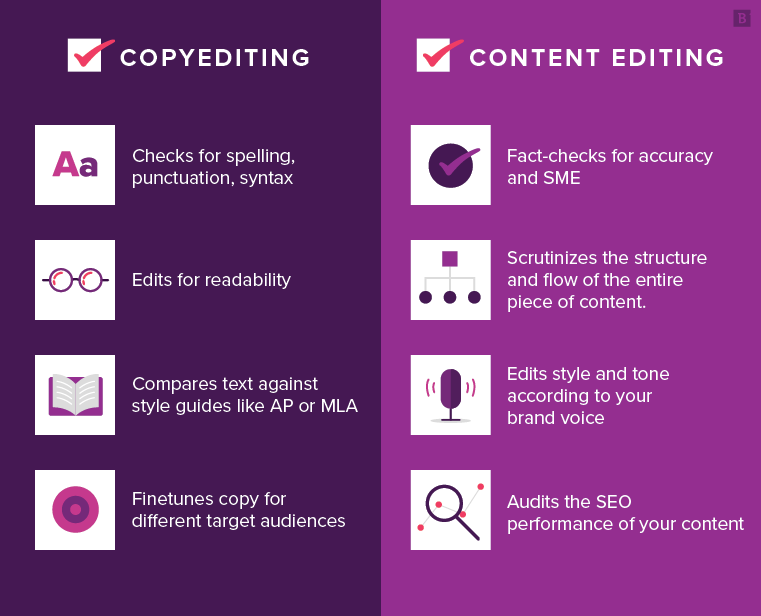
| Copyediting | Content Editing |
| Checks for spelling, punctuation, syntax | Fact-checks for accuracy and SME |
| Edits for readability | Scrutinizes the structure and flow of the entire piece of content |
| Compares text against style guides like AP or MLA | Edits style and tone according to your brand voice |
| Finetunes copy for different target audiences | Audits the SEO performance of your content |
As you can see, content editing vs. copyediting is more than just semantics. They both have their separate, but no less important, areas of focus. Mastering each one is essential to consistently creating quality content that ranks high in Google SERPs, drives organic traffic to your site and provides actual value to your audience.
If you think a spellchecker can do a good content editor’s job, think again. In reality, you need a robust content strategy that includes editing, proofreading, thorough editing services and professionals who truly understand the craft. The right people can and will adapt their skills to any context — be it academic editing, book editing or blog and website content editing for global audiences.
By embracing the difference between these two arms of content refinement and applying the right editing methods, you empower your brand to consistently improve writing fidelity, clarity and impact.
Editor’s Note: Updated October 2025.