
The Content Marketing Weekly is every marketer’s must-have – it’s pretty much your morning coffee. In this week’s edition we have updates on Google’s ranking algorithms and search functionality, a prime example of how CRO works and insight into the habits of the world’s best content marketers.
Dive in.
Google Search App to Suggest Related Content
As further proof of just how consequential mobile search has become, Google announced that its Google Search app for iOS now includes an update that enables users to find related content without having to go back to the search bar and type in additional queries.
Similar to how desktop SERPs display related content organically, mobile apps now have the same functionality accessible by swiping up from the bottom of the screen.
Search Engine Journal noted that based on its initial interaction with the feature, the app doesn’t appear to personalize suggested content but rather relies on historical browsing trends. So, if other users tended to read a given article after viewing the page you landed on, you’d likely be served that same article within the related content section.
Google is hoping to expand this feature to other countries and devices, though for the time being, it’s available only in the U.S. and through the iOS Google Search app.
But based on Google’s history of setting the tone for the rest of the search world, it’s likely we can expect all mobile devices and apps to mirror this latest foray in the coming year.
Read more on what this new development could mean.
The Anatomy of a $97 million Page: A CRO Case Study
Imagine increasing direct sales by 91 percent through conversion rate optimization. That’s exactly what happened recently when Protalus, a global footwear company, partnered with The Conversion Wizards, a CRO and web analytics consulting firm.
Over the course of six months, The Conversion Wizards did the following:
- Implemented post-purchase one-click upsell CTAs: 21 percent boost in sales.
- Moved “free expedited shipping” CTA to the top of the page: 145 percent lift in conversions.
- Added celebrity testimonials: 60 percent bump in conversions.
- Redesigned main sales pages with longer-form content: 58 percent conversion rate increase.
Additionally, the team made site performance improvements to speed up load times and created custom follow-ups to common customer complaints.
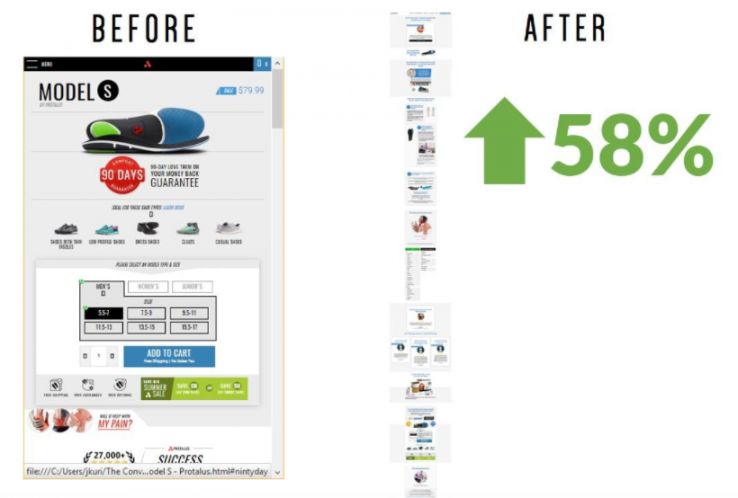
The total result of these efforts was what’s being called a “$97 million page” based on the future projections of the page’s performance post-optimization. In the next 12-18 months, the optimized page will dramatically increase Protalus’ valuation and raise annual run-rate revenue by 1,212 percent.
Now if that’s not enough CRO testimony to provide to your CEO, then we don’t know what is.
Read the rest of the case study here!
Google: Top Ranking Factors Change Depending on Query
If you’re still trying to center your content around comprehensive keyword targets for the year, it’s probably best to stop right now.
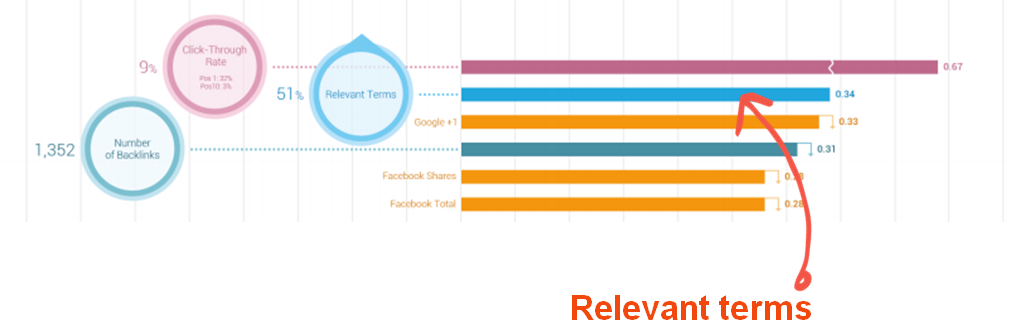
This article from Search Engine Journal clears up long-standing rumors about how Google’s algorithms work. Most marketers believe there are defined ranking factors that they should accommodate across their content strategy. However, two Google webmaster trends analysts, Gary Illyes and John Mueller, clarified on Twitter that there are, in fact, no pre-set ranking factors that trump all others.
The algorithms try to show relevant & awesome results to users’ queries. Everything else varies. Opt’ing for factors is short-term thinking.
— John ☆.o(≧▽≦)o.☆ (@JohnMu) September 18, 2017
In effect, building content around specific ranking signals is a recipe for disaster. Every piece of content is graded as a standalone asset that is accorded unique value in the eyes of search algorithms.
Google’s intent is to rank more highly content that is relevant to users – everything other potential ranking signal varies.
That means marketers should spend less time stuffing specific keywords across all content and approach each asset as an individual experiment.
Read on for more ranking factor clarity.
New Research Reveals Habits of Top Content Marketers
The Content Marketing Institute released its 8th annual content marketing survey, and 65 percent of B2B companies reported greater year-over-year content marketing success in 2017.
So what are these successful marketers doing right?
Well, for starters, they:
- Have a documented strategy that’s rated as “sophisticated” or “mature.”
- Have a high level of commitment to seeing it through.
- Have realistic goals.
- Have consistent delivery.
- Have built in time to dedicate to content.
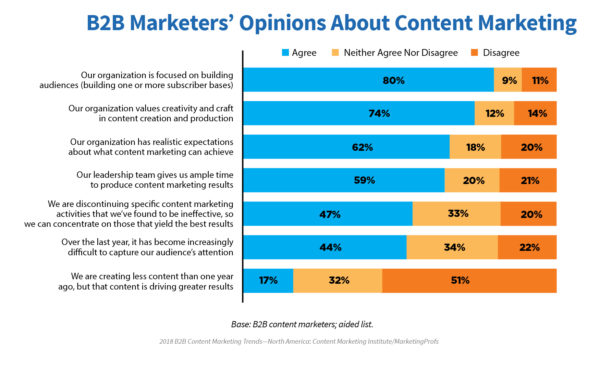
Via contentmarketinginstitute.com
The top-performing content marketers stated they are focusing more of their time on building a larger audience, producing high-quality creative content and refining their project management workflow.
This last point indicates that creativity and process don’t have to butt heads, as CMI pointed out. The best content marketers can do both, and do it effectively.
To see how your organization stacks up to other B2B marketers, click here for the full-length report.
That’s it for now. Come back next week for more content marketing insights.