
Seemingly, everyone is talking about AI. They talk about it with excitement, fear, anger, hope, quiet confidence and also the type of loud confidence that makes you distrust them. But who’s actually using AI? Well, as it pertains to marketing, Brafton can answer that question.
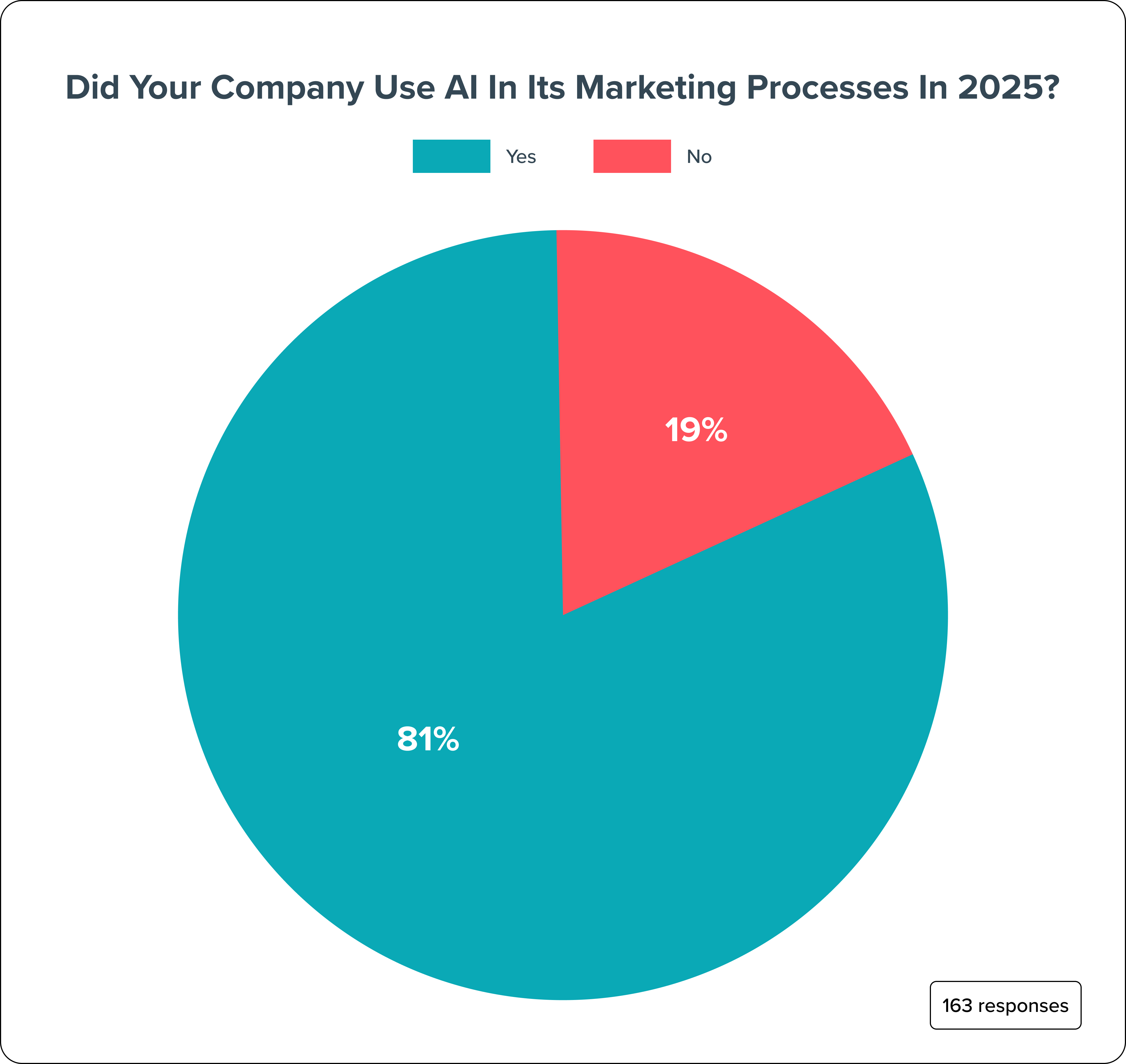
We surveyed marketing professionals and received 163 responses. These responses informed our 2026 white paper and blog series on AI in marketing. Today, we’re getting into the 131 people who said they’re using AI, and what that can tell us about our industry.

So, Who’s Using AI in Marketing?
Our survey found 81% of respondents use AI. This blog looks at the responses of those 81%. (Interestingly, this is a very close percentage to our results from last year’s survey.)
With new technologies, young people are typically the first adopters. Young millennials supported Facebook’s growth two decades ago, and Gen Z flocked to TikTok more recently — not to mention your five-year-old who figured out how to download apps you’d never heard of to your smart TV.
Couple this with the fact that AI tools, such as large language model (LLM) chatbots, are most adept at completing tasks associated with entry-level positions, and you could reasonably expect young people to use AI more than older people. And you’d be reasonably surprised.
We grouped our respondents by seniority level. Here’s how it breaks down among AI users:
- Entry-level (0-2 years): 11.54%
- Intermediate (3-5 years): 14.62%
- Mid-level (6-10 years): 17.69%
- Senior (11+ years): 56.15%
While we didn’t specifically classify respondents by age, there probably aren’t many marketing professionals under 30 with over 11 years of experience. And yet it’s this senior professional group that accounts for the majority of AI usage among the four. They use AI more than three times as much as the next closest group. Fascinatingly, this trend wasn’t apparent in last year’s survey.
Subscribe to
The Content Marketer
Get weekly insights, advice and opinions about all things digital marketing.
Thanks for subscribing! Keep an eye out for a Welcome email from us shortly. If you don’t see it come through, check your spam folder and mark the email as “not spam.”
Management at the Helm
These results may seem counterintuitive, but our data align with those of other surveys showing a correlation between the height of one’s position and the likelihood of using AI regularly. And while individual contributors were more likely to use AI than CEOs and executives (23.66% to 14.5%, respectively), the largest AI users by far are marketing managers and directors — a whopping 61.83%.
Why is this? Ultimately, we can’t say with certainty. Maybe leadership is actively testing the waters, trying to understand the tools properly before delegating or building department-wide processes. Maybe the current suite of AI tools available lend themselves to the kinds of administrative tasks managers and directors do frequently.
AI, Size and Industry
What kinds of companies are using AI? The answer is, “the vast majority of them,” but some more than others. Here’s the breakdown, starting with size:
- Small (1-20 employees): 36.92%
- Medium (21-50 employees): 20.00%
- Large (51-500 employees): 26.92%
- Enterprise (501+ employees): 16.15%
The largest group is the one representing the smallest organizations. This is likely a result of small teams using AI as a force multiplier to punch above their weight. They may use AI to stretch limited resources to compete with larger entities. They may also have more flexibility — and fewer guardrails, with 31.25% of small companies and 23.08% of medium-sized companies having an AI policy vs. 62.86% of large and 61.90% of enterprise companies noting the same — meaning staff may have more freedom to try out AI tools.
Which Industries Use AI the Most?
We found marketers & creatives, and technology & IT professionals, use AI more than respondents from other industries, with more than 90% of respondents from these two fields indicating AI use. Survey takers from professional & business services; manufacturing & industrial; education; and e-commerce, retail and distribution also indicated AI use.
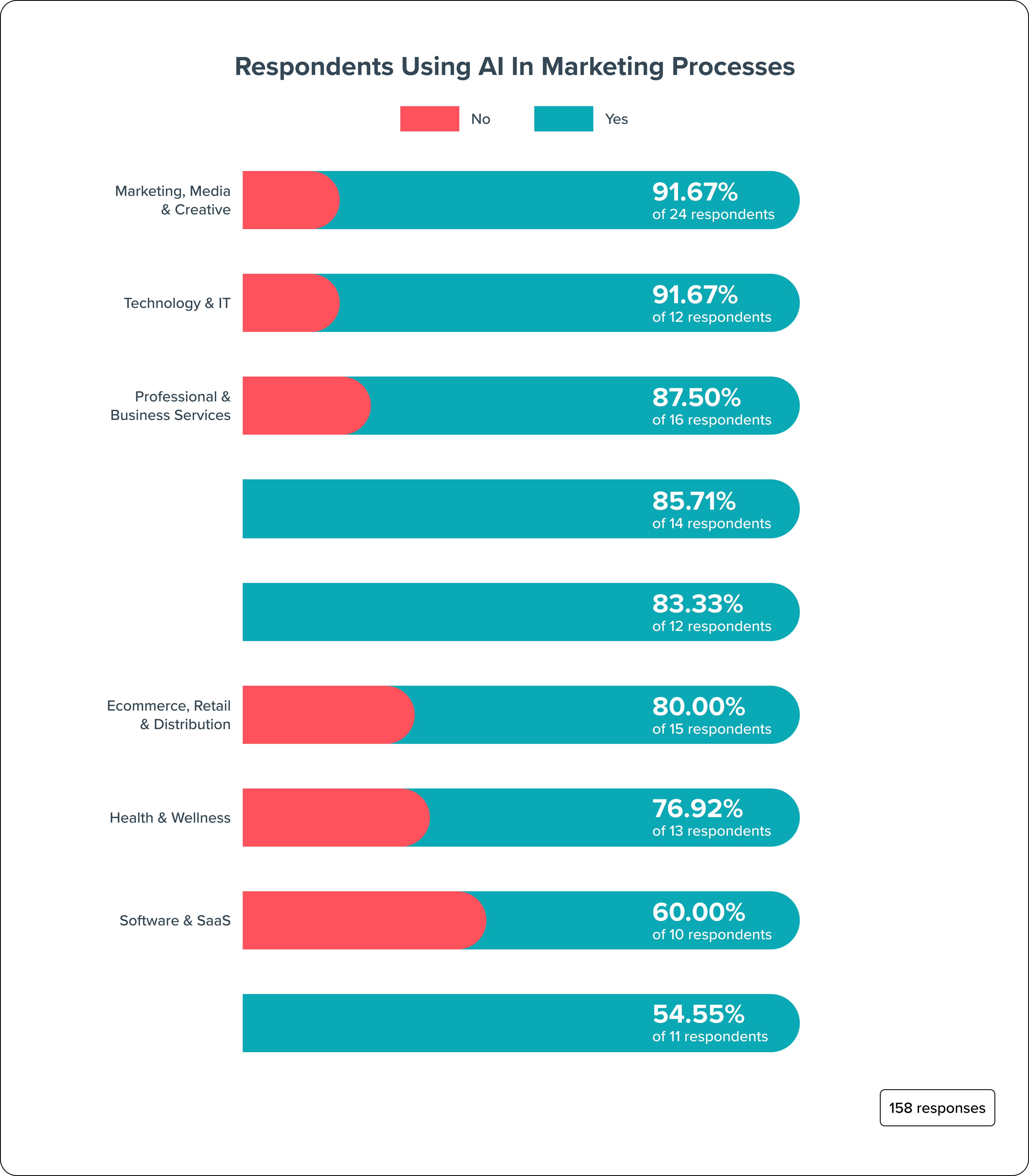
- Marketing, Media & Creative: 91.67% of 24 respondents.
- Technology & IT: 91.67% of 12 respondents.
- Professional & Business Services: 87.50% of 16 respondents.
- Manufacturing & Industrial: 85.71% of 14 respondents.
- Education: 83.33% of 12 respondents.
- E-commerce, Retail & Distribution: 80.00% of 15 respondents.
- Health & Wellness: 76.92% of 13 respondents.
- Software & SaaS: 60.00% of 10 respondents.
- Nonprofit & Social Services: 54.55% of 11 respondents.
How Are They Using AI Tools?
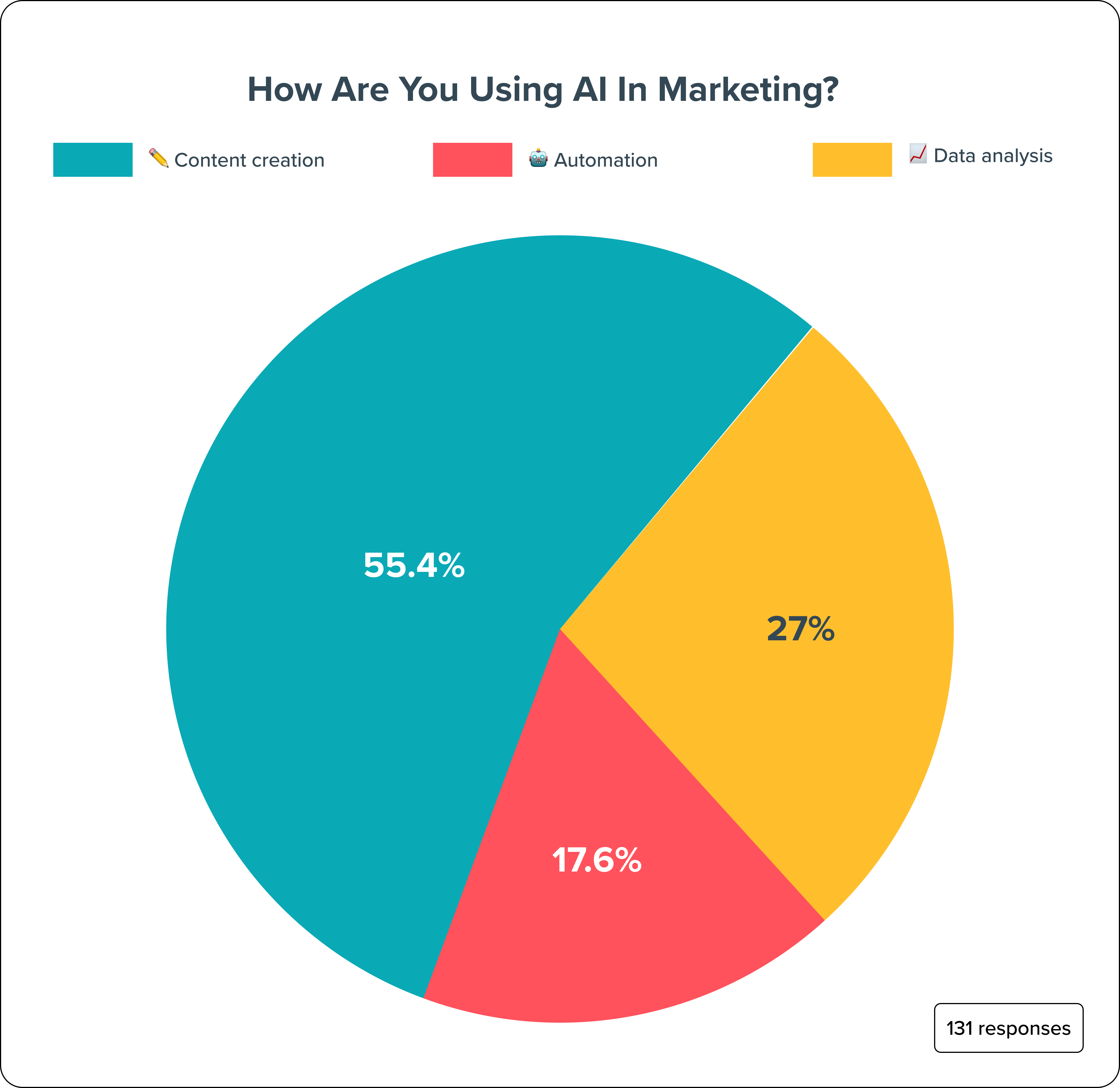
Content creation is the chief output of AI so far. It accounted for over half of our responses, with data analysis and automation following.
But How Are They Using AI?
When a marketing professional uses an AI tool to create content or analyze data, what do they do next? Simply send it up the chain and pat themselves on the back for a job well done?
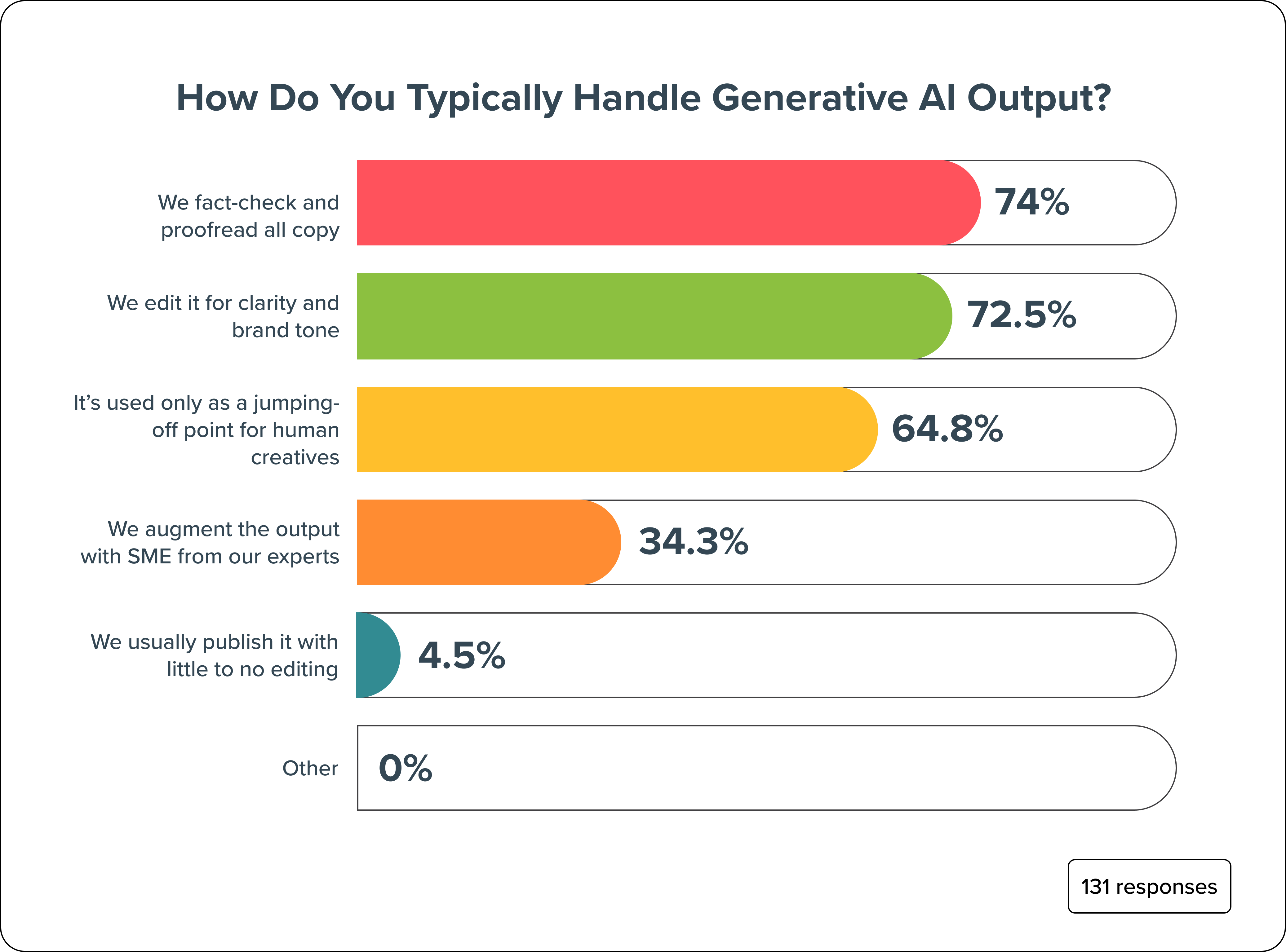
Rarely. It appears marketing professionals are generally more careful with their AI outputs. They use AI as one step in a multi-stage process, cleaning up, fact-checking and/or customizing what the AI gives them.
We also asked about specific tasks. Research and planning (57.25%), ideation and brainstorming (54.96%), outlining (45.04%) and headlines and metadata (41.22%) lead the way. This suggests that AI is a useful remedy for writer’s block.
Marketing professionals are using AI for numerous tasks around writing, more than they are for actually writing the copy itself. However, this is a fairly popular task for AI, too — 37.4% said they’ve used AI to generate website copy. Still, given that a majority of professionals fact-check, edit and augment AI output, it appears that AI tools act mostly as writing partners, not writers themselves.
Last, it’s worth noting that “automation” is the smallest segment of our pie chart. Everywhere we hear of AI “automating tasks.” However, as regards customer support chatbots, scheduling emails or posts, workflow planning and personalization, very few of our respondents said they use AI in this way. This suggests that while generative AI tools such as LLM are proving useful, agentic AI tasks seem to have a slower adoption rate.
What Tools Are They Using?
We often speak of AI as if it were one thing. But of course, different technologies and tools can use artificial intelligence. When it comes to marketing, we found that ChatGPT is the most popular tool — by a wide margin.
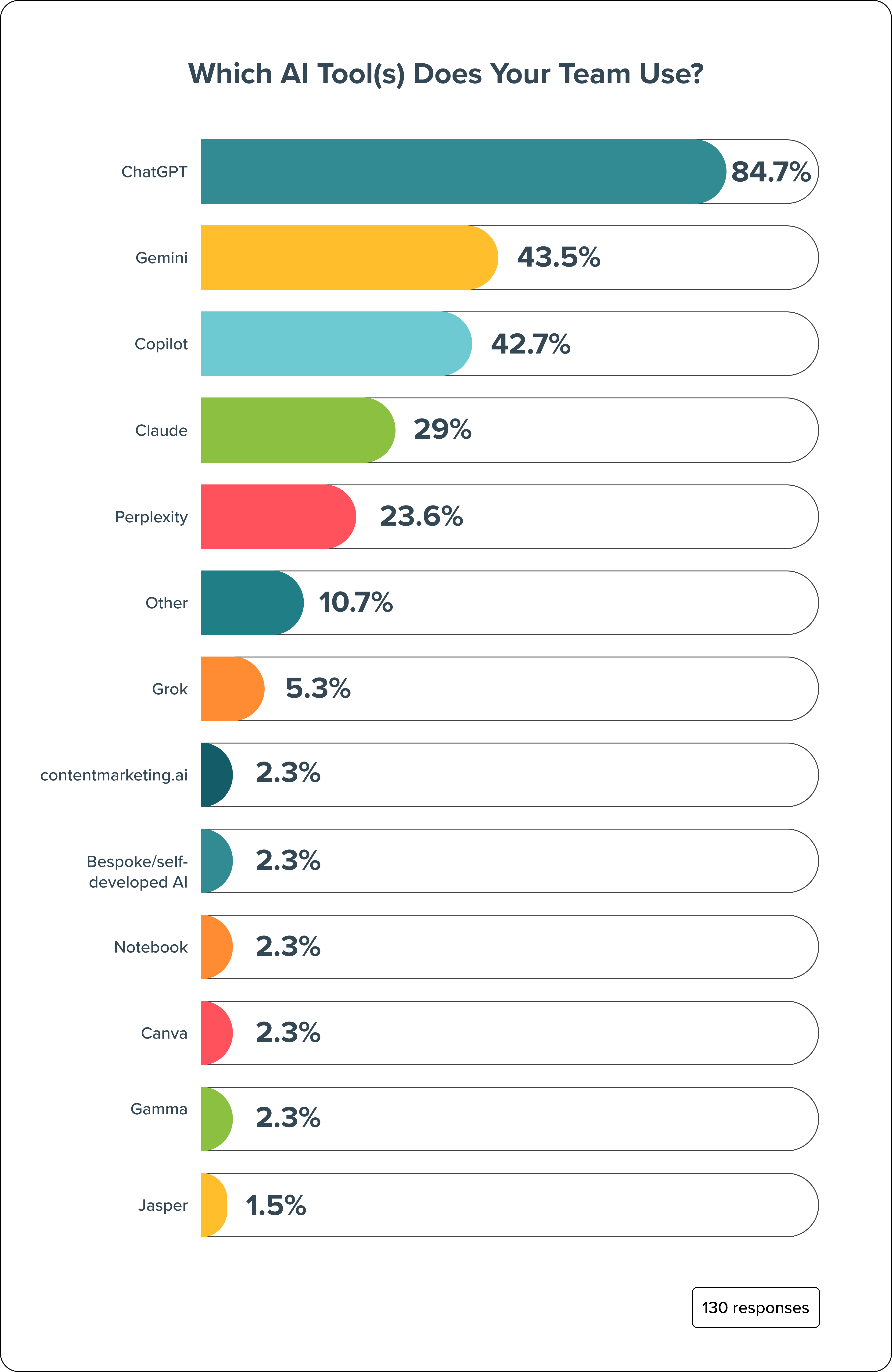
Even if you’ve never used an AI tool, you’ve likely heard of ChatGPT, and our survey agrees with other publicly available data on the comparative popularity of LLMs. However, it’s worth mentioning that generative AI is a nascent technology and it, along with public perceptions of it, is changing fast. While ChatGPT is the most popular this year, next year may be a different story.
The Wild West?
AI might feel like it’s everywhere, but these tools are still new. And leaders have relatively little oversight of how their teams and departments use AI. An eye-catching 61.07% of respondents said they had no AI training and were just learning as they went. Further, only 42.75% say they have AI policies to refer to — a trend we discuss in more detail in our blog about AI policies.
For those concerned with privacy, proprietary data and accuracy, these are disquieting numbers. Nonetheless, a bottom-up approach could help AI governance. Individual staff may figure out how to best make AI work for them, and this can inform a company-wide policy.
How Do Marketers Feel About AI?
Will AI radically disrupt the marketing industry, including huge new advances, quicker outputs and conversion rates of 99%? Or will AI merely result in massive job losses and a prevalence of “slop” throughout the industry? According to our respondents, the answer is … neither.
When asked for their outlook, a majority (53.79%) felt that AI is enabling incremental or gradual growth. About 10% specifically said they saw AI as support for marketers, not as a replacement. About the same number said they were cautiously optimistic.
Key quotes include:
- “It’s easier to use on an individual level than a systems-wide process.”
- “AI will continue to play a part in our marketing, particularly to generate additional assets from content already created (i.e., social media posts based on human-written articles). It won’t ever be the sole point of content creation.”
- “Can be a good tool to help with human oversight.”
- “I think (and hope) AI will be used to simplify the tasks that can be automated and assist the humans in the actual creation of content. I am opposed to video and image generation, as it is inauthentic and can mislead customers.”
- “It’s a supremely useful tool, but I do fear that things will start all sounding the same in marketing and advertising if we aren’t careful. It will all become AI slop.”
- “It’s inevitable. It does create a lot of slop though, and most people are distrustful of AI content, so discretion is key.”
- “Marketers can only optimize AI if they use critical thinking on how and when to utilize it”.
- “I believe it will continue to refine into a useful tool rather than a replacement for human creativity.”
What Does It All Mean?
It means most marketers are using AI, and beyond that, we have a spectrum of opinions and approaches going on.
Clearly, there are many use cases for AI tools in marketing and related industries. And there are many hopes and much optimism, but there’s also some amount of unease. As marketers and the public get more used to AI, and as companies draft policies for its use, these clouds of uncertainty may pass and illuminate our new normal.