

The broad majority of consumers and companies use telecommunication every day, and that’s why creating a telecom marketing strategy that capitalizes on this fact is a matter of survival. Consider the market penetration of cellphones, and smartphones in particular:
- 85% of Americans say they own a smartphone.
- 77% of Americans own a home broadband subscription.
- 100% of consumers aged 18 to 29 have cellphones (94% have smartphones).
By building deliberate brand awareness of a telecom brand and appealing to specific customer preferences, businesses can more effectively convert this widespread adoption into loyal telecom customers. A well-crafted approach that addresses customer behavior and aligns with a company’s overall marketing efforts can boost customer acquisition and nurture ongoing customer relationships.
Given the growing usage and dependence on telecom services, these companies’ target audiences are wide-reaching and quite diverse. Thus, telecom companies are tasked with creating marketing strategies that appeal to many potential consumers and solve a plethora of challenges.
Telecom Marketing Strategies That Work
Thanks to modern data analysis and the ever-evolving marketing landscape, telecom services can adjust their services and support to meet customers’ different needs. A successful telecom marketing strategy blends insights about customer behavior with tactical initiatives like targeted marketing campaigns and personalized marketing. Here are some tried and true types of marketing strategies that have exhibited telecommunications business success:
Check out our printer-friendly guide here.
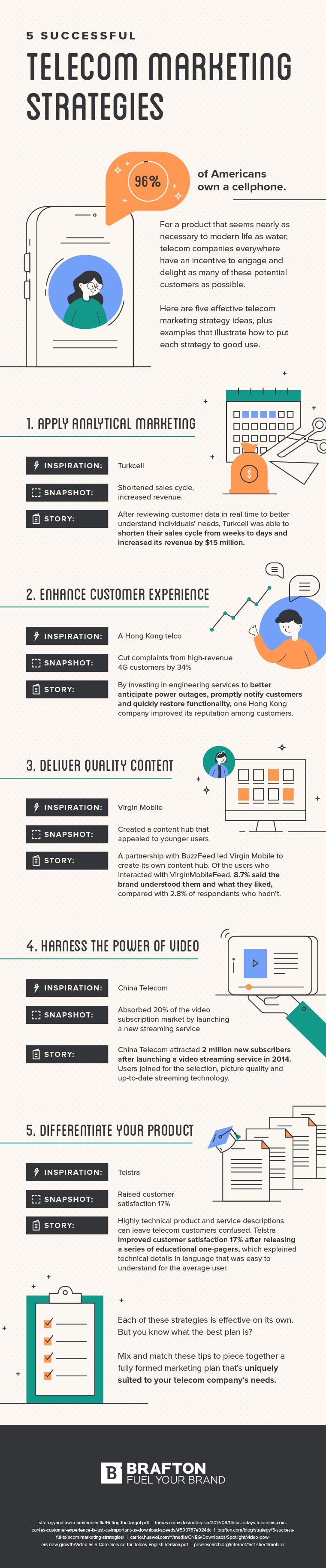
Check out our printer-friendly guide here:

Apply Analytical Marketing
Telecommunication companies provide an enormous number of services, but most customers are only interested in a select few. By leveraging a telco or telecom marketer’s ability to gather data on telecom audiences and analyze customer preferences, companies can craft personalized marketing campaigns that speak to each telecom customer directly.
Through analytical marketing, you can gain insight into customer data and identify which clients will most likely benefit from each of your products. To do this, you’ll create microsegments of consumer information or buyer personas that describe individuals on a customer journey rather than big-picture trends.
For companies seeking to optimize their supply chain and better anticipate customer demand, integrating demand planning software into their analytical marketing strategies can provide a significant competitive advantage. Once you’ve got that data, you can even cross-reference it to inform your social media and email marketing.
Once you’ve learned about your target audience, it’s easier to detect specific behaviors that should prompt a new product offer. For instance, existing customers who frequently send texts to friends in other countries might be interested in upgrading to an international data plan.
Analyzing these patterns allows telecom providers to quickly adapt their marketing campaigns in tandem with nuanced digital marketing strategies, ensuring the right offerings reach the right telecom audiences at the right time.
The first step in leveraging analytical marketing is to gather data. Companies need to strike a balance between obtaining high-quality, comprehensive information and maintaining trust with the consumer.
With the increasing capabilities for data mining, consumers have become protective of their personal information. Shady practices like obtaining and using data without notifying the customer, or selling and buying information from third-party sources have left consumers scarred and wary. Failing to address these concerns can harm brand visibility and weaken customer relationships.
Ironically, consumers also become frustrated when they perceive companies to not have a good understanding of their needs or when they offer random products rather than relevant ones. This complex dynamic means telecommunications businesses must gather high-quality information, but use it in a responsible, transparent way.
Instead of blindly hoarding information, Comcast uses Pointillist, their proprietary analytics tool, to document customer journeys and interactions with their brand.
Thanks to AI data analysis, they can see where the customer experience still needs work, whether that’s in their mobile app or during a support call handling. While many of us might not associate AI with personalization, solutions like these actually provide CRM enrichment and allow businesses to leverage the information they already have more efficiently. For telecom marketers, this can form the backbone of personalized marketing strategies that build long-term customer trust.
Subscribe to
The Content Marketer
Get weekly insights, advice and opinions about all things digital marketing.
Thanks for subscribing! Keep an eye out for a Welcome email from us shortly. If you don’t see it come through, check your spam folder and mark the email as “not spam.”
Enhance Customer Experience
One of the biggest hurdles telecommunications marketing departments must clear is the industry’s reputation for poor customer service and user experience. According to CustomerGauge’s Net Promoter Score®, which measures customer satisfaction and experience, telecom brands are known to be the constant underperformers.
If that wasn’t enough of a challenge, PwC finds that the telecom industry is facing waves of innovation threatening their basic communication services, from Voice over Internet Protocol (VoIP) services to the infrastructure cost of 5G to the restructuring of our internet ecosystem through Web3 standards.
Overcoming the industry’s bad reputation is critical for marketing strategies to succeed. If the customer doesn’t believe they’ll have a positive experience, the consumer engagement process is much more difficult. As such, many telecom companies are beginning to invest in an improved customer experience. This type of investment not only influences customer acquisition but also fosters brand awareness by portraying the telecom brand in a more positive light.
There are numerous approaches for improving the customer experience because there are so many ways for companies to go wrong. However, adopting intentional marketing efforts that focus on relationship marketing can help telecom audiences feel valued and heard. One way to provide a better customer experience is to simply put it at the core of your entire business operation.
Macquarie Telecom Group, an Australian telecommunications company, made the bold move to cut traditional customer surveys out of their operation. Instead, they put the Net Promoter Score into every part of their business, from hiring processes to marketing strategies and customer service. As a result, they won the World Communications Award only a few years later.
The telecom space is increasingly becoming more competitive, which means consumers have options. The industry is taking notice, though. One recent example is T-Mobile’s “uncarrier revolution,” which helped the company grow its customer base from 33 to 72 million users.
Most of that success can be attributed to an overhaul of their customer experience, from creating multiple access points for customers to surprise data packages during soccer games and solid UX research informing their proprietary apps. This kind of telco company initiative combines digital marketing strategies with robust customer relationships, transforming the brand into a customer-centric powerhouse.
Luckily, examples like T-Mobile’s abound, but companies that strive to improve the overall consumer experience will always find it much easier to retain loyal customers. Satisfied telecom audiences often share their experiences through referral marketing, lending even greater brand visibility to companies that excel in service.
Get the full guide to these strategies here:
Deliver Quality Content
Providing the type of content that a target audience actually wants to read is a great way to stoke customer engagement. That was Virgin Mobile’s idea when they partnered with BuzzFeed, which frequently produces popular content aimed at a young demographic.
In an effort to capture consumers in the 18- to 24-year-old age range, the telecom company created its own news hub called VirginMobileFeed and staffed it with a BuzzFeed-trained editorial team. The hub frequently features content, video and links to Virgin’s social channels to entertain this younger demographic.
The fun-forward strategy captures customer attention and builds a sense of friendliness that serves to improve its brand image. A study of the initiative found that 8.7% of respondents who had interacted with the provider’s content felt Virgin Mobile was a brand that understood them and the things they like, compared to just 2.8% of people who hadn’t. Further, 10.3% of those exposed to the initiative were considering Virgin Mobile for their next phone, while 4.1% of those who weren’t said the same. This example also underscores how personalized marketing can form a pivotal part of every telecom marketing strategy.
Of course, not all consumers are interested in content following the stylings of BuzzFeed, which means telecom companies need to take into consideration the pain points of their current and potential customers. A content marketing strategy that includes assets that answer consumer questions and solves common problems shows that the company can be a helpful partner. By strategically aligning this approach with marketing efforts, a telecom provider can strengthen both short- and long-term customer relationships.
Harness the Power of Video
When Verizon chose to invest in video for its product pages, the company saw an increase in viewer conversions in addition to reduced call center volumes something that medical services can achieve instead by using emergency dispatch software for triage and call routing in real-time over the phone. In other words, the videos helped consumers understand the product better and created a more intuitive and seamless experience. This underscores the significance of campaigns that use direct visual aids to capture interest, highlight product features and differentiate each telecom sector brand from its competitors.
Samsung has also embraced video, but focuses their efforts on creating memorable commercials that highlight the differentiating features of its phones compared to its main competitor, Apple. In videos that they promote on YouTube, they demonstrate the pain points that switching to Samsung can solve, like waiting in long lines at retail locations and software glitches. These videos act as marketing campaigns that reinforce brand messaging throughout the telecom industry.
Product promotion and explanation aren’t the only ways video can serve to entice consumers. Telecom companies that create their own video services can also bring in new customers and engage existing ones.
That’s just what BT Group, a British telecom company, did with the launch of a new live TV service in 2006. Adoption was slow at first, but BT worked out a range of deals with Microsoft, Sky Sports, Netflix and other providers. Even in tough markets, the company sees more customers coming their way to this day. By consistently refining their marketing strategies, BT Group has remained a significant player in the telecommunications business.
Differentiate Your Product
Product complexity and dissatisfaction are key issues for many telecommunications companies. A 2023 report found that while critics claimed U.S. broadband speeds were slow, the data doesn’t support that. This hints at the great discrepancy between factual evidence and user experience, which may be linked to anything from consumer choices to non-transparent pricing structures.
Vague and somewhat meaningless product names like “turbo” and “ultra” don’t provide clarity, either. Tackling this issue can help improve satisfaction because customers may begin to view the telecom company they use as being more transparent and honest about services (even if it already was). Australian company Telstra did this by providing one-pagers describing in clear, simple language the product packages the customer purchased. Within just a few months, the company saw a 17% increase in satisfaction.
Confusing products and titles can be a detriment to the consumer experience, but so can products that don’t meet expectations. Understanding customer behavior can help brands create offerings that satisfy their customers. For instance, targeted marketing campaigns can position new offerings to the right audience at the exact right time.Highlighting the benefits of the products available through marketing is essential in standing out from the crowd. Staying updated with telecommunication trends can provide valuable insights that help refine telecom marketing strategy and meet evolving customer demands. Adding features, such as Virgin Mobile’s entertainment hub or China Telecom’s video streaming service can also capture attention and drive brand visibility.
Mix and Match Marketing Activities to Achieve Success
Marketing in the telecommunications industry must be an all-inclusive effort that begins with a sound understanding of who your target customers are (and there likely will be many categories here), what they need and how they get their information. Each of these five marketing tactics can work together and support success.
For example, your analytical marketing can help inform methods like product differentiation, and video marketing can improve the overall customer experience. By synchronizing multiple campaigns that reflect relationship marketing and direct marketing principles, telecom marketers can build strong customer relationships that translate into better customer acquisition.
These days, the scale of operations alone will almost force you to adopt modern data analysis techniques and AI to support your operations. So for traditional service businesses like telecommunications especially, planning new partnerships with utility providers will make or break future success. These alliances and digital marketing strategies can help a telco company expand its network and deepen its marketing efforts in new regions.
In the end, establishing feelings of trust and reliability will help to generate happy customers who are more likely to be loyal to your brand. A marketing agency that specializes in telecom marketing strategy can also provide a comprehensive approach to boosting brand awareness and forging lasting customer relationships.
Editor’s Note: Updated July 2025.